
According to Jason Koop’s Training Essentials for Ultrarunning, gastrointestinal distress is the leading cause of DNFs in ultramarathon running. I believe him. I have been close to contributing to that statistic.
The summer of 2019 was when I first understood that what you eat before a run is not a neutral decision. I was training for the Berlin marathon, doing my long runs along the Teltowkanal in Berlin. One Sunday I went out after a breakfast of scrambled eggs and bacon. It was hot. Somewhere around kilometer eighteen, the warning signs arrived. I pulled over, asked my friend and bike companion for a tissue, and disappeared into the bushes. I came back out nauseous. I nearly had an accident in my running shorts.
It was not the last time something like that would happen.
The Jurek phase
Around the same period I stumbled across Scott Jurek again. I had read about him first in that Economist article about Spartathlon, years earlier in a Bonn library. But now I went deeper. I read Eat and Run, his account of ultrarunning and veganism.
Jurek’s argument is that a plant-based diet helped him recover faster, fuel more efficiently, and ultimately win races like the Western States 100 seven consecutive times. He also pushed back against gels, not because they are not vegan, but because they represent a kind of shortcut away from real food. His preference during races was fruit, nuts, seeds. Things that exist in the world, not things manufactured to pack glucose into a sachet.
I was not ready to go fully plant-based. But I took one part of it seriously: before every long run, I would follow a vegan diet. And during runs, I replaced gels almost entirely with dried cranberries and dates.
I ran the Berlin marathon that autumn. Gray and rainy. Came in under four hours with a hydration vest full of water and a handful of dried berries. As soon as I crossed the finish line, I thought: let’s go further.
Hungary and the iso drink problem
Before attempting the Mauerweglauf 100-miler race in Berlin, I needed a race in between. I found the Balaton Szupermarathon, a four-day stage race around Lake Balaton in Hungary. About 196 kilometers in total, roughly 49 kilometers per day. I packed my dried fruits, loaded up on pasta the night before the start, and thought I was ready.
False.
On day one, I made a decision that seemed logical at the time. Instead of carrying water and salt separately, why not just carry an iso mix? One hydration vest, two problems solved. By hour three, I understood why this was wrong. What had tasted vaguely of lemon at the start now tasted like something I wanted to pour out to the lake.
The concept is called flavor fatigue. A flavor you liked becomes genuinely repulsive after hours of continuous exposure. By the time I had finished the first stage, I never wanted to see that iso mix again.
I went back to plain water and berries for days two through four. I finished, but I was visibly underfueled. The body had not gotten what it needed.
The first Mauerweg
The 2020 Mauerweglauf was postponed due to the pandemic. I kept training. That summer I ran my first 50-miler, and in November my first 100k, both on sections of the Mauerweg itself, my friends waiting for me at various points with food and water. Those training runs introduced two things I still use: alcohol-free beer during long efforts, and instant ramen. Neither is particularly glamorous. Both work.
By August 2021, when the Mauerweglauf finally ran, I arrived with what I thought was a complete fueling system. Carefully portioned packages of cranberries and peanuts. Dates stuffed with peanut butter, wrapped in cling film. Avocado and black bean burritos in my drop bags, made the nights before and kept wrapped. Two gels, just for emergencies.
It was a hot day. Everything went well until it didn’t. Somewhere around kilometer 60 I started hating my berries. I reached my drop bag and looked at the burrito. It was no longer fresh. I took two bites. That was it for the burrito.
The rest of the race was less of an athletic effort and more of a scavenger hunt for foods I could tolerate. I finished. I went straight home and passed out on the floor for seven hours. I needed a fueling strategy that worked all the way to the finish line, and I did not have one yet.
Transgrancanaria and the return of gels
After the Mauerweglauf I stepped away from big races for a while. Surfing, travel, other things. When I came back to racing in 2024 at the Transgrancanaria, I knew I had to adapt. I was abroad, without my kitchen. I also could not tolerate dry berries anymore. I needed to eat what was available at the aid stations and what I could carry in my vest.
I had been watching an interview with Courtney Dauwalter, who talks openly about using candy and comfort food during races. The idea got into my head: not everything has to be clean or principled. Sometimes you just need calories, and the body will accept gummy bears when it has rejected everything else.
I introduced gels full time into my plan for Gran Canaria. The diversity helped. But the problem returned in a new form. When everything on the table is sweet, gels and candy and carbonated drinks, the sweetness itself becomes overwhelming. The flavor fatigue problem had not disappeared. It had just changed shape.
The mash potato revelation
At the following Mauerweglauf, I tried instant mashed potatoes for the first time, prepared the night before at home. The effect was immediate and almost embarrassing in its simplicity. A savory, warm food with real texture landed completely differently than anything else I had been eating. I could eat more of it. I did not feel sick afterward. I continued running.
That same year I read Koop’s book on ultrarunning and discovered salty rice balls. The recipe is simple: cooked rice, honey, soy sauce, and eggs. You end up with something savory and sweet at the same time, dense in carbohydrates, with enough sodium to actually matter. I made batches before training runs and started testing them in races.
The Japan problem
I was heading to Mount Fuji 100 and could not fly in with a bag of homemade rice balls. Japanese border control does not like that particular carry-on. I packed a few gels and some candy and figured I would sort it out on the ground.
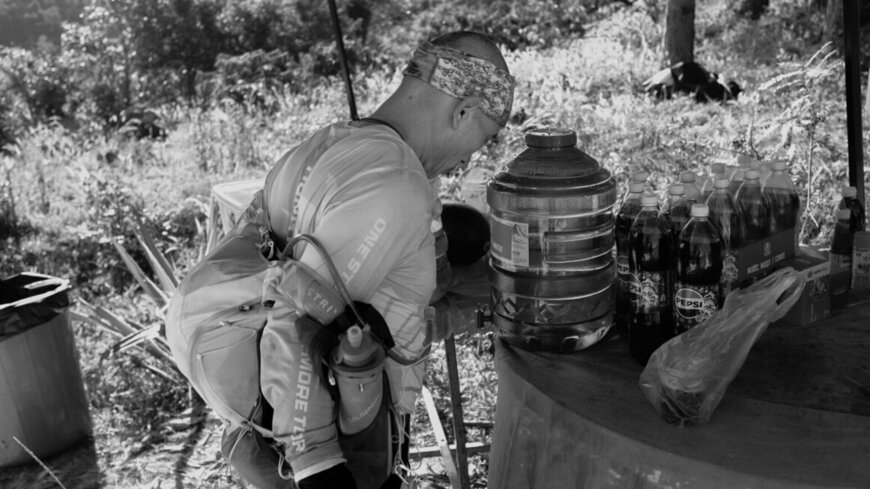
The local 7-Eleven near the race start sorted out part of it. Onigiri, the triangle-shaped rice and seaweed snacks that are everywhere in Japan, turned out to be good enough: portable, savory, real food. The Mount Fuji aid stations added mushroom soups and ramen, which covered the sodium side of things. But by kilometer 60, I had run out of ideas for the gels. Flavor fatigue arrived on schedule.
The pattern was becoming clear. I could solve the problem at home, in my kitchen, with my own recipes. As soon as I crossed a border, my dependency on gels increased, and the solution collapsed.
Cappadocia and the powder fix
Before the Cappadocia Ultra Trail in Turkey, a friend suggested instant mashed potato powder. Not a warm station meal, but a powder I could travel with and prepare anywhere with just hot water. Add some plant-based milk, olive oil, salt, and pepper. You end up with something that tastes like actual food and travels in a 100-gram bag.
This was the unlock I had been missing. A savory, reliable food I could bring into any country, prepare in a hotel room, and know would work in my stomach.
At the same time, I forced myself to revisit carbohydrate mixes. The iso drink disaster in Hungary had put me off them for years. But I could not keep avoiding them entirely, not with longer races in the horizon. I started slowly, introducing small amounts alongside foods I already trusted, going for long runs specifically to test my stomach rather than my legs.
After several weeks of testing, I landed on a coconut-flavored carb mix from MNSTRY. What makes it work, for me, is the flavor profile. Most carb mixes on the market use a sharp, acidic fruit flavor that makes you more thirsty the longer you drink it. The coconut version has a milky, mild quality. I also found flavorless gels that I can take without triggering the same response. I have reduced my gel intake to roughly one per 50 kilometers, only when I need a fast hit without stopping.
I brought the powder, the carb mix, and the flavorless gels to Cappadocia. Hot, dry, exposed terrain. It was the first race where the fueling held together from start to finish. No scavenger hunt this time. The system worked.
What goes to Greece
The plan for Spartathlon is a combination of everything that has survived the testing: instant mashed potatoes, salty rice balls, the MNSTRY carb mix in coconut, and a small selection of flavorless gels and candy for variety. Cold alcohol-free beer when possible. The logic is the same logic that has guided all of it: diversity, sodium, avoiding anything that will turn on me after hour ten.
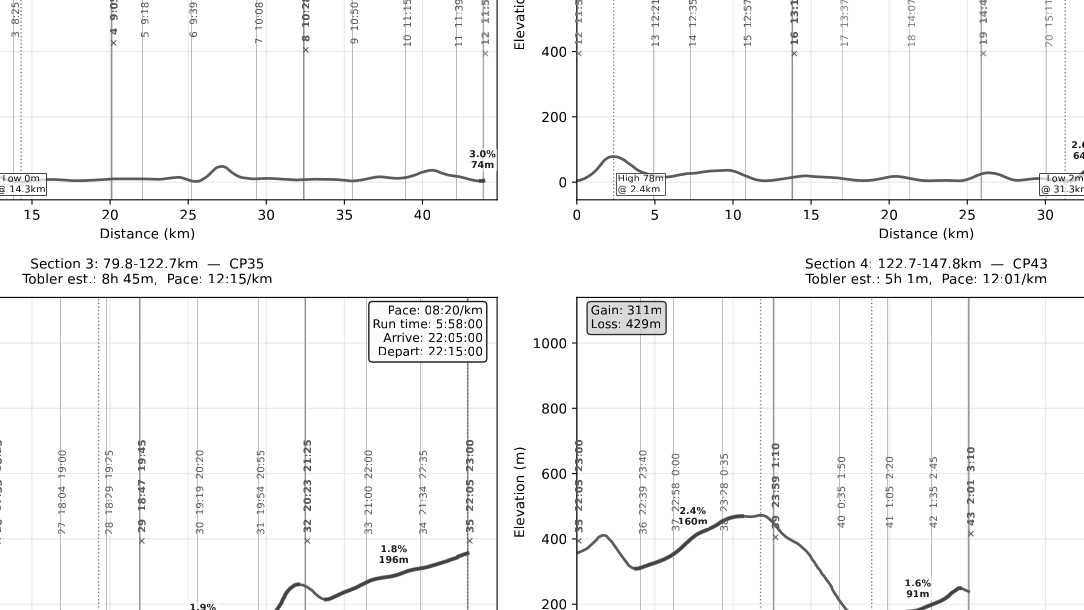
The specific challenge of Spartathlon is duration and heat. A finish will take me somewhere between 32 and 36 hours. September in Greece is not September in Berlin. The body sweats more, needs more sodium, processes food differently at elevated temperatures. The target I am working from is 55 grams of carbohydrates per hour, the same intake that held up for me in the heat at Cappadocia. All of this summer’s long runs will be done with the full fuel kit, in conditions as warm as Berlin can offer. Not the same as Greece but is better than nothing.
Koop’s observation about GI distress is easy to dismiss as a statistic until you have lived it a few times. Then it stops being abstract. The fuel plan is not a detail. It is one of the things that will determine whether I reach Sparta.