

Six weeks in, and it feels like solid work.
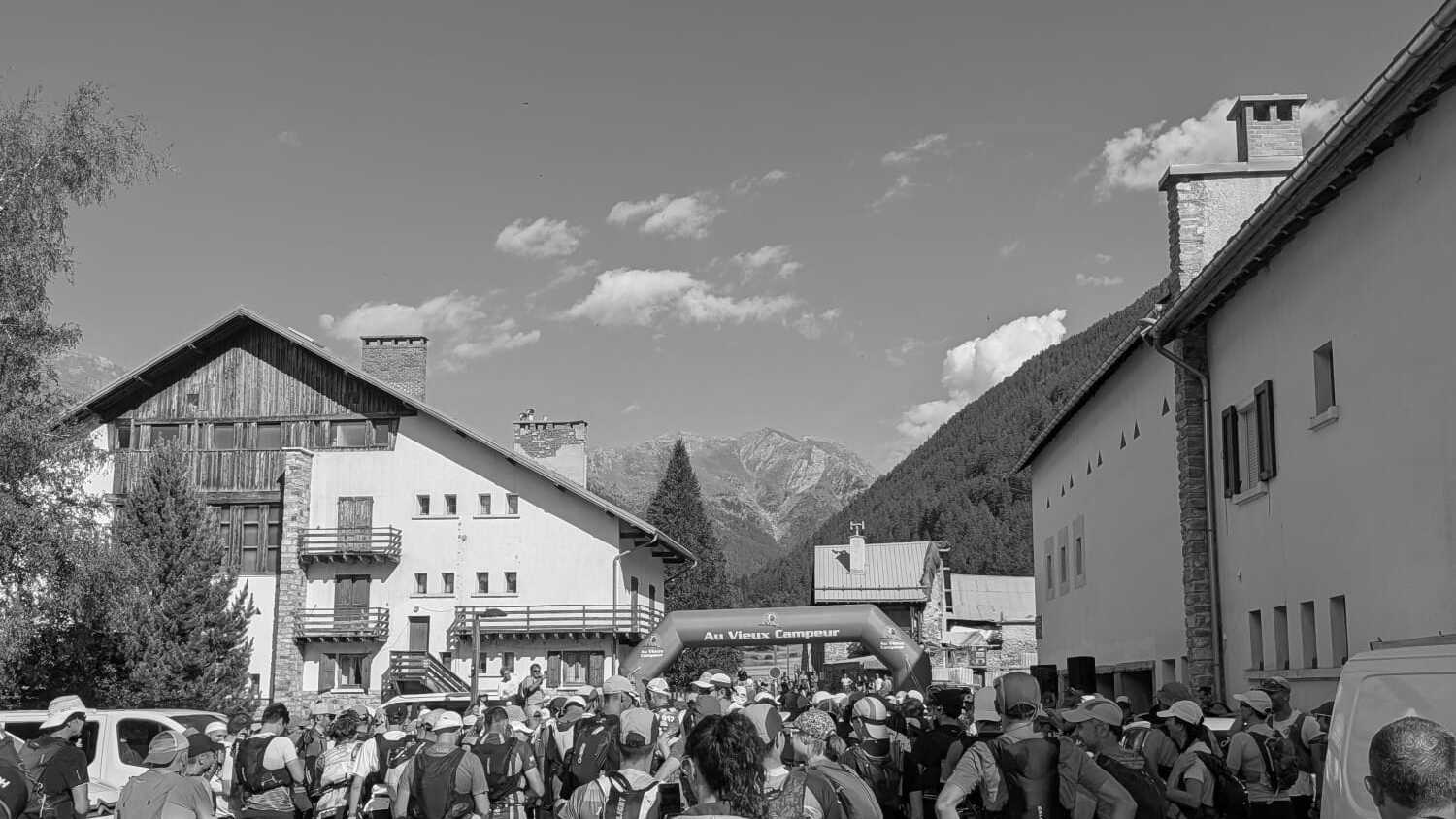
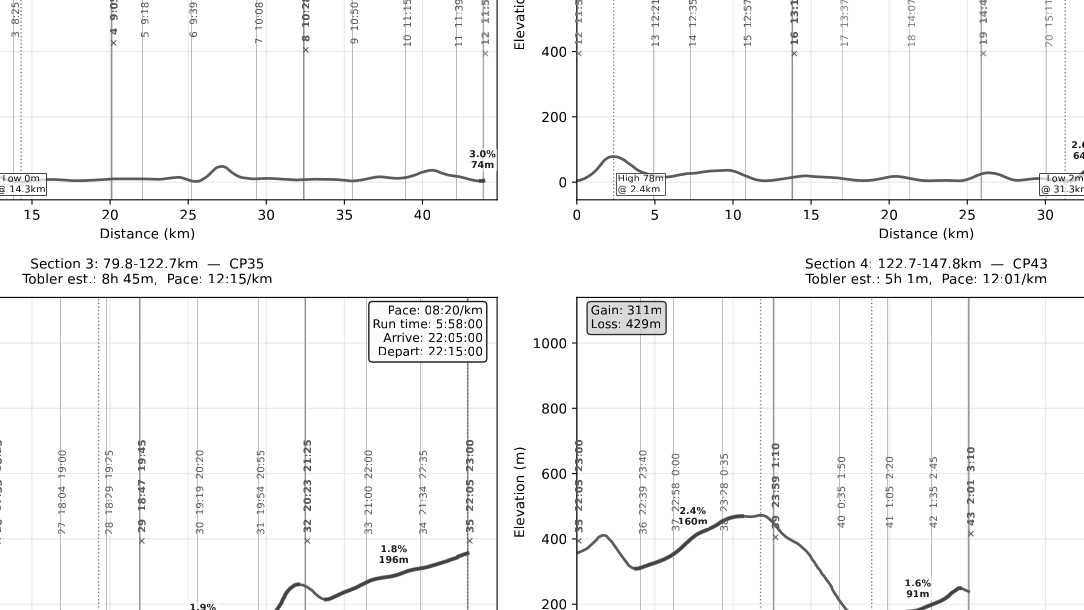
I’m writing this the night before the Grand Raid du Guillestrois, carboloading and watching the forecast, which is now promising a lot of sun on top of the altitude and exposure I already wrote about. Before I head into that, I wanted to look back at weeks 21 through 26, the run-up to Queyras.
The gap between plan and reality
I’ve been tracking cumulative distance and elevation against the original plan. Distance has tracked reasonably close to target. Elevation has consistently lagged.
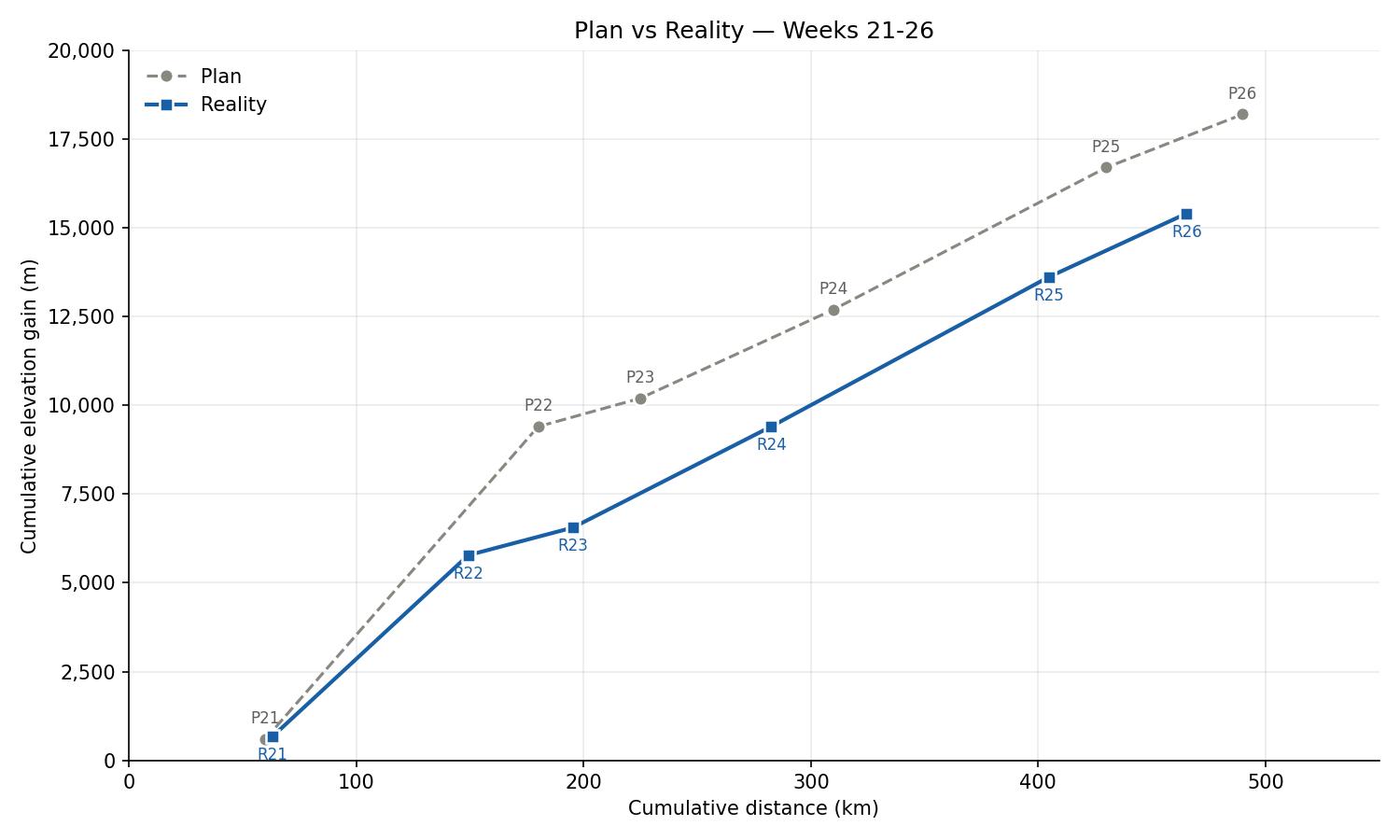
The gap opened in week 22, during the Everesting challenge. I stopped at 5,012 meters of vertical, roughly half of the 8,848 meter goal. I wrote about that decision already: an honest half Everesting over a broken full one, especially this early in a Spartathlon build. That single week accounts for most of the elevation deficit, and the gap has held steady rather than closed since. I haven’t tried to chase it down aggressively, and I don’t think I should. It should come back naturally to plan in the next few weeks. Distance has been easier to hit. The volume is there. It’s the climbing that Berlin makes difficult to achieve.
The loop that taught me about silence
Week 25 included a 44 kilometer long run that ended up being the most instructive session of the block, for reasons that had nothing to do with pace.
I ran out of daylight hours to get to proper terrain, so I stayed in the park near home instead of heading out to Grunewald. To hit the elevation target for the day, I needed 16 loops of about 2.3 kilometers each, with roughly 100 meters of gain per loop.
The first twelve loops were fine. After that, it got boring in a way that pure distance rarely does. Few people in the park, heat sitting on the paths, and the same 2.3 kilometers of scenery cycling past for the fifth or sixth time. I don’t run with music normally. I save it for when things get hard, a rule I’ve kept for years. That evening, somewhere around loop 13, I understood why I keep it in reserve. I wanted it badly, and the pace drop through loops 14 and 15 probably says as much.
The same thing came back to me from the Everesting night in Grunewald. Running the same short slope for hours in the dark, alone with my own footsteps, is a different kind of hard than covering new ground. Repetition asks something of your attention that distance alone does not. Spartathlon will have a rule against headphones, so this is probably useful information to have now rather than at kilometer 180 in Greece.
The body keeping score
Six weeks of building volume is starting to show up in small ways.
Stretching is harder than it used to be. General stiffness has crept in. And there’s a light discomfort in my right Achilles, specifically when climbing hard. It follows a predictable pattern: worse at the start of an uphill, fading once I’m warm, and reduced to tenderness by the next day. Nothing that has changed how I run or made me skip a session, but it’s the kind of signal I wrote about back in May, the one where the job is to read it accurately rather than optimistically. I’m watching it, not ignoring it.
Hunger has gone up noticeably, and my weight has swung by about 4 kilos over the six weeks. Up and down. Both are consistent with the volume increase and not something I’m worried about yet, but worth noting for when I look back at this block later.
What’s actually working
The heat side of things has been genuinely encouraging. It has been hot in Berlin the last few days, and instead of it slowing me down, I’ve felt comfortable running through it. Some of that is the frozen flask trick from Montañita, already back in rotation. Some of it might just be that heat adaptation from earlier training is holding. Either way, it’s the first concrete evidence this summer that the heat plan is doing something rather than just being a plan.
What’s next
Once Queyras is behind me, the next phase of this build starts, and it comes with gear questions I’ve been putting off. Vest versus belt. Sleeves versus sleeveless versus long sleeves. I have opinions from past races, but nothing tested specifically against what Spartathlon will ask for: heat, long duration, minimal carrying if I end up leaning on the aid station spacing the way I’ve been considering. Shoes and shorts are on that list too. That testing starts properly after this weekend.
For now, the plan is simple. Finish Queyras with a controlled effort, not a time. Come back, close the gap between plan and reality where it makes sense to, and leave the parts that don’t need chasing alone.