
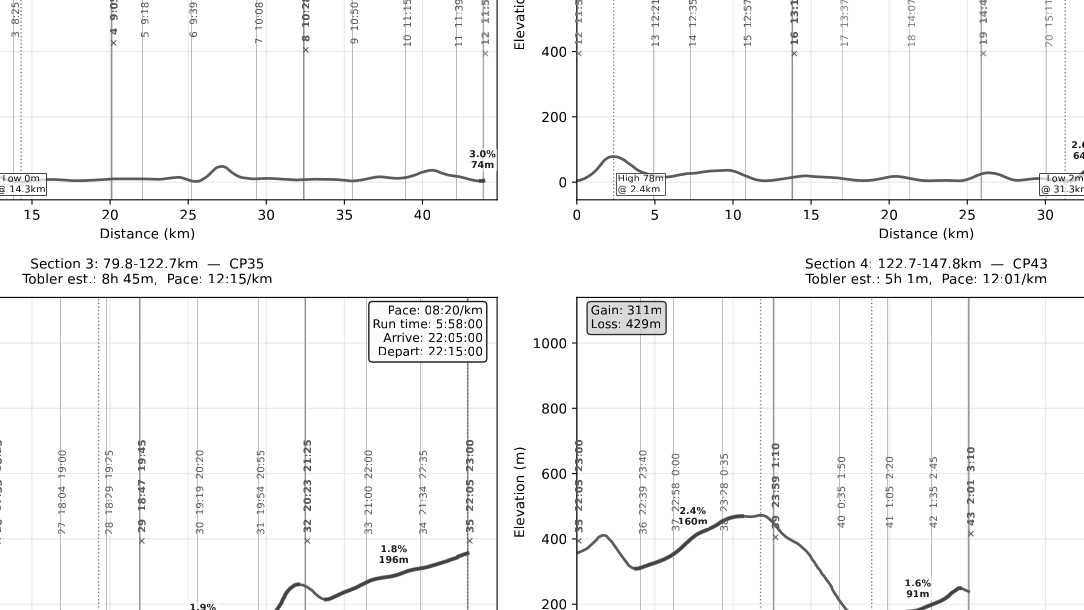

The last bit of trail in the training block is behind. From here it is mostly road for a couple of months into Spartathlon, the highest volume stretch of the build and the time to stress test the gear going to Greece. Starting with shoes.
Spartathlon is close to 246 kilometers of (mostly) asphalt, for up to 36 hours. Whatever I put on my feet in Athens has to survive that without becoming the reason I stop moving.
The Pureboost and minimalist years
I ran my first half marathon, trail race, marathon, and ultra, all in some version of the adidas Pureboost DPR. The exact pairs blur together in memory, probably the same model worn down over and over.
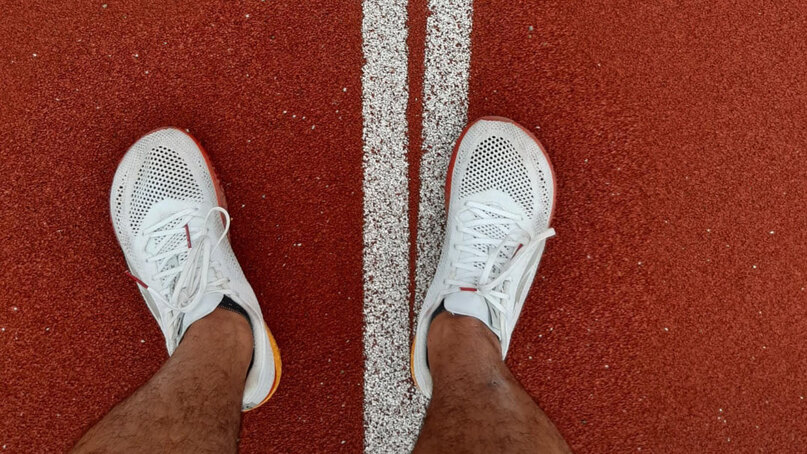
Training for my first hundred miler, the idea of doing less appealed to me, and with shoes that meant Altra. A friend pointed me to the Escalante line: wide toe box, zero drop.
I went through two pairs of Escalantes in training. Close to race day, I bought the Escalante Racer, a shoe so light it felt like wearing socks instead of shoes. I ran the entire Mauerweglauf 2021 in them, no rotation. The race gave me plenty of problems, but never with my feet.
Starting over, on purpose
After that hundred miler I stepped away from long distances for a while. Surfing took over, with stretches of time in the Canary Islands running trail loops through Fuerteventura. I decided I was done being an adidas runner by default and wanted to try other brands.
Salomon Sense Ride 3 was first, and it did not go well: too narrow for my feet, and the only shoe that has ever given me blue toenails on the first run. Then Hoka, the Speedgoat 4 and Torrent 2, tested in Tenerife. Almost no impact from the rocks underfoot, which felt strange rather than good. I wanted more feedback from the terrain than either gave me. Returned all three.
Back at the shop, I asked for advice, and ended up with the Brooks Cascadia 14. I could feel the trail again. I upgraded to the Cascadia 15 with no complaints. For a while it was simple: Cascadia for trail, Escalante for road and track.
A detour and the comeback
A stretch of plantar fasciitis in 2022 and 2023, unrelated to the shoes, put me out for over a year.
Coming back ahead of Transgrancanaria 2024, I wanted something new, and finally tried the Asics Trabuco. It is, to date, the best shoe my feet have worn, trail or otherwise: stable, comfortable, fairly priced. I ran Transgrancanaria in that pair and put close to a thousand kilometers on them.
Four more pairs of the Trabuco 12 followed, carrying me through most of my races since. I am down to my last pair now, alternating trail runs with the Hoka Speedgoat 6 and Brooks Cascadia 17.
The road side of the story
Most of my running is trail now, but road never fully goes away: local running clubs in Berlin, vacation half marathons, and every Mauerweg.
For Mauerweg 2024, fresh out of plantar fasciitis, I went back to Adidas for the Boston 12, alternating it with the Cascadia and saving it for the final 60 road kilometers. The toe box was fine. It worked.
The following year, for Mauerweg 2025, the qualifying race for Spartathlon, I ran the same pattern, switching around kilometer 90, this time into the Boston 13. I hit my time, but the shoe was not the same. The 13’s toe box is noticeably narrower than the 12’s, and my feet swell with distance regardless. Past kilometer 60, it started to feel like the blood had simply stopped moving down there, the kind of tightness where the only real fix is taking the shoes off.
The one constant
One thing never changed through all of this: CEP compression socks, mid or low cut, worn under every pair on this list, adidas to Asics. I never think about them the way I think about shoes. They keep my feet dry and the blood moving. Crucial for long distance running.
The search
RunRepeat, a site whose reviews have lined up with my own experience closely, is how the Asics Novablast line ended up on my list.
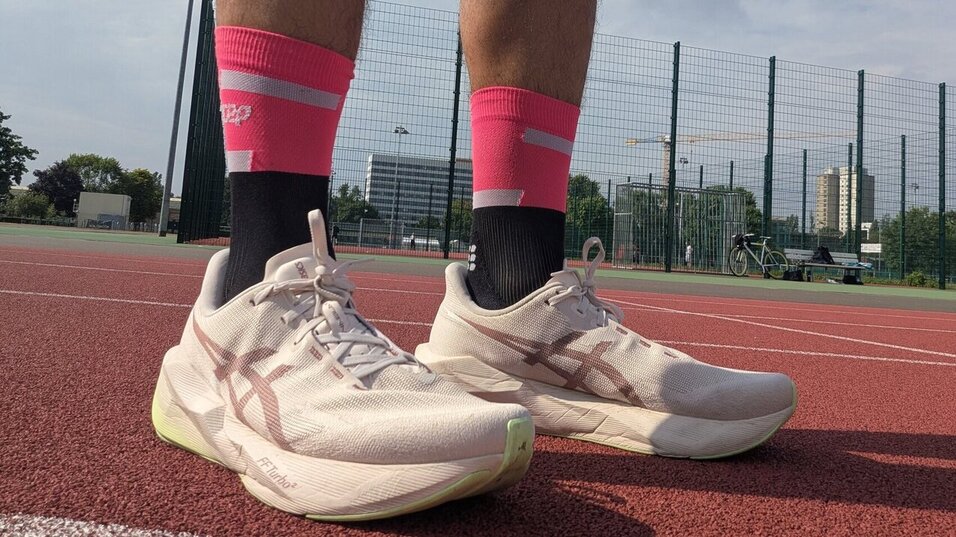
I took the shortlist to a shop in Charlottenburg called Lunge and tried three Asics road models in one session: Novablast, Superblast, Megablast. The Super and Mega were too bouncy and unstable once I was actually moving. The Novablast landed in the middle: light, responsive, stable enough. I took that pair home.
What goes to Greece
Cumulative testing sits around 100 kilometers now, across flat ground and hills, heat and rain, no complaints so far. But the longest single run is only 30 kilometers, nowhere near what race day will ask. The next five weeks step up on purpose: 40, then 60, then hopefully 80, to see whether the shoe holds under one sustained effort rather than a string of shorter ones. If nothing unexpected shows up, this is the shoe.
Race day itself will not be one pair but two or three, all Novablast 6, each with different mileage on the sole, so my feet are not subjected to the same compression for a day and a half.
Sizing needed its own adjustment too. My regular shoe size is a 43. In Asics trail models I have always needed a 45. For Spartathlon, accounting for a day and a half of swelling on top of that, I am going with a 46, three sizes up from where I start in normal life.
I have a good feeling this is the shoe. What is left to prove is durability under real distance, which the next five weeks will answer.