

So here is the plan for a summer of grueling training.
Between now and September 26th, I intend to cover roughly 2000 kilometers and 40,000 meters of vertical ascent. That works out to about 20 weeks of running, ending on the day I cross the finish line in Sparta. Or don’t. The number sounds large when you say it out loud. It is roughly the distance between Berlin and Madrid according to Google Maps. On foot.
What follows is what that looks like on paper, and the honest list of things that will try to break it.
The Schedule
Here is the plan, week by week. The first week being the week of this writing.
| Week | Km | Vert (m) | Phase | Notes |
|---|---|---|---|---|
| 21 | 60 | 600 | Rest | Easy week before Everesting. Vilnius half with friends |
| 22 | 120 | 8800 | Effort | Everesting challenge. Just participate, don’t race to finish |
| 23 | 45 | 800 | Recovery | Flat and easy. Legs will be burning from W22 |
| 24 | 85 | 2500 | Build | Back to normal volume, reintroduce vert |
| 25 | 120 | 4000 | Peak | Peak week for Queyras. One long effort day, back-to-back days |
| 26 | 60 | 1500 | Taper | Reduce volume, keep some vert |
| 27 | 100 | 5800 | B Race | Grand Raid du Queyras. Goal is to enjoy, controlled finish |
| 28 | 35 | 500 | Recovery | Genuine rest week |
| 29 | 90 | 1500 | Build | Spartathlon block begins. Volume focus, mostly flat |
| 30 | 115 | 2000 | Build | Stepping up. Introduce long days, keep effort controlled |
| 31 | 140 | 2200 | Build | Strong build week, mirrors pre-Berlin pattern |
| 32 | 160 | 2000 | Build | Highest build week, continue long days, flat and steady |
| 33 | 160 | 800 | C Race | Mauerweg relay or hold 160 km build |
| 34 | 60 | 800 | Recovery | Drop volume before peak week. Keep legs moving, nothing hard |
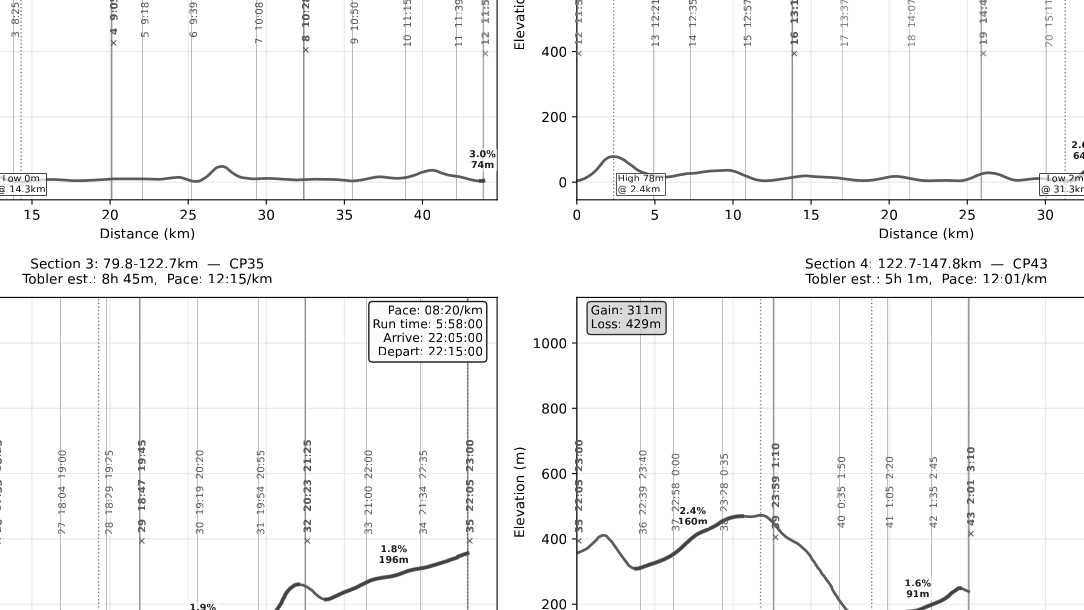
| 35 | 245 | 2000 | Peak | Mon rest, Tue–Wed ~42 km easy, Thu 60 km hard, Fri-Sun ~35 km easy |
| 36 | 90 | 1500 | Taper | All easy effort, no long days |
| 37 | 65 | 800 | Taper | Keep dropping volume |
| 38 | 40 | 400 | Taper | Short daily runs, sleep and eat well |
| 39 | 246 | 2000 | A Race | Spartathlon |
| 40 | 25 | 200 | Recovery | Walk, sleep, eat a lot |
The Philosophy Behind the Peak Week
I have scheduled week 35 to be 245 kilometers. That is almost the full distance of Spartathlon itself, crammed into six days.
The idea I work from is that the peak training week before a race should match the race in volume and, where possible, in character. The body needs to have already experienced something close to what race day will ask of it. Not so that race day feels easy, but so that it does not feel entirely new. There is a physiological argument for this, but the mental one matters just as much. When you are at kilometer 180 in Greece and your legs can no more, it is useful to remember similar moments from training. How overcoming is part of who you are as an endurance runner.
I have applied this to every major race in recent years. Before Mt. Fuji 100, in March of last year, I left flat Berlin four weeks out and went to Tenerife, where I put in over 180 kilometers with 7,000 meters of vertical for peak week. The goal was to get the body to adapt to climbing and descending and climbing again, even if on tired legs. It worked well enough.
Before the Mauerweg last August, I logged a 160-kilometer peak week, mostly flat road, which mirrored race day well. I had no real options for a course nearby. As I wanted to simulate the race as much as possible, I needed to have food and water readily available. Replicate the aid-station every 7 kilometer setup of the Mauerweg. So I ran 56km around the track in my neighborhood, stopping to refueling and switching direction every 7 kilometers to simulate the race. A few people reached out afterward having spotted me doing what must have looked like a very repetitive and slightly worrying kind of madness (how did Kouros manage?). I expect this summer will involve a few more sessions of exactly that kind.
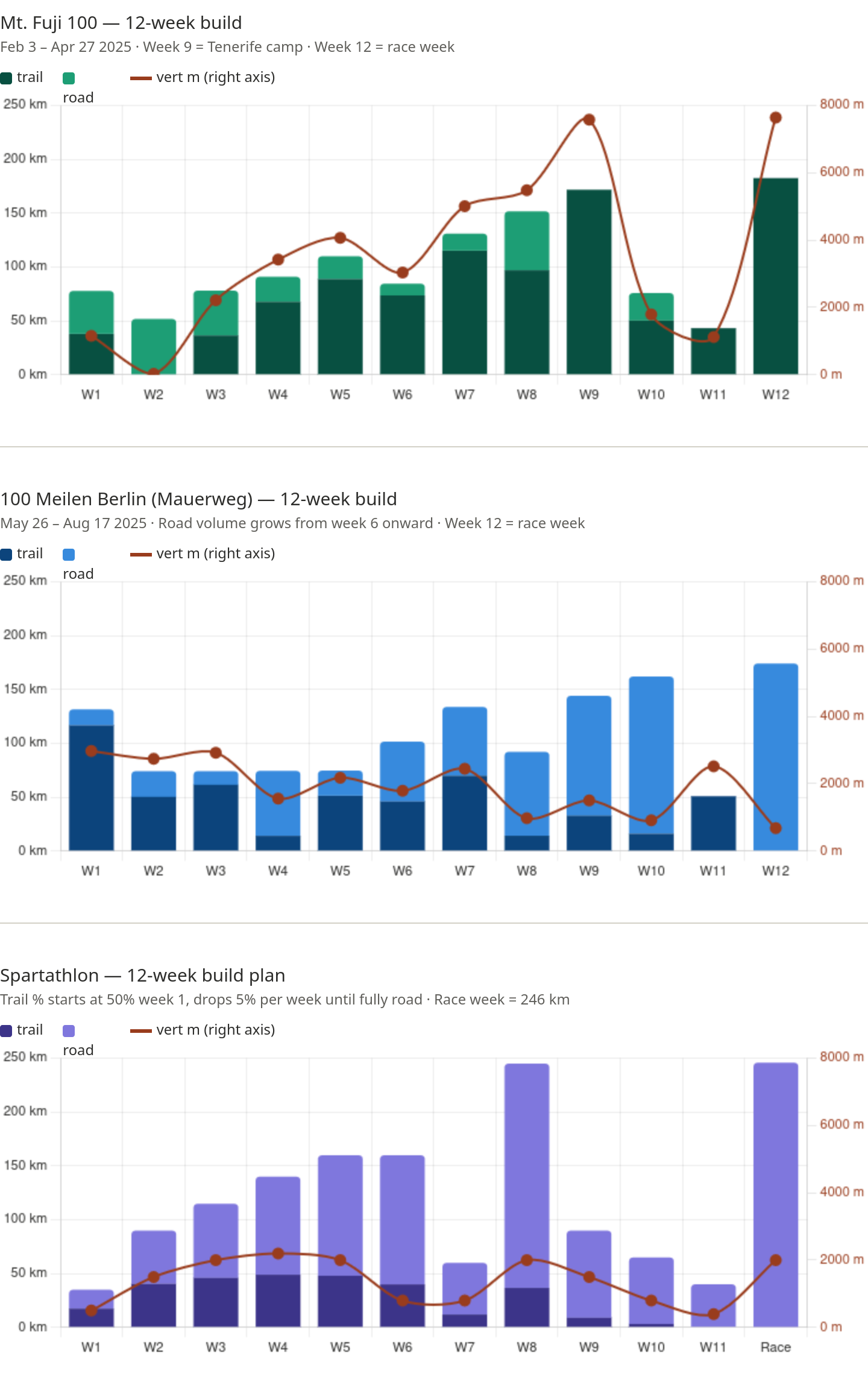
For Spartathlon, the peak week is structured around the race’s nature: mostly road, long consecutive days, moderate vertical. The 60-kilometer hard day on Thursday is the spine of the week. Everything else is designed to accumulate fatigue around it so that the body learns to keep moving when it would rather not.
How the Build Actually Works
The block does not start with long runs. It starts with conditioning.
In the early weeks, the priority is general fitness: intervals, hill repeats, zone 2 work, terrain variety, volume spread across the week. This is the foundation. Without it, the later volume has nowhere to land.
As the weeks progress, the training shifts to resemble the race more closely. More road, less trail. Fewer runs per week but each one longer, 40 kilometers and above. More sessions in the heat of the day, because Spartathlon in September in Greece is not a cold-weather event and there is no point arriving at the start line having trained exclusively in the cool Berlin mornings.
By the time the Spartathlon block begins in Week 29, the work becomes almost single-minded: accumulate flat road kilometers, back-to-back long days, controlled effort. Think less, absorb more.
The Things That Will Complicate This
As with all planning, it is about preparing for the worst and hoping for the best. Here is what I am already bracing for.
The B and C races. The calendar includes two races alongside the main build. In Week 22, the Berlin Trail Runners, the running group I am part of, are attempting an Everesting challenge: a running effort that accumulates over 8,848 meters of vertical, the height of Mount Everest. In one of the flatest cities on earth. The goal is to participate and finish, not race it. Still, 8,800 meters of vertical in a single week is a significant load, which is why it sits early in the block, far in character from what Spartathlon will demand. Better to absorb that now than later.
In Week 27 comes the Grand Raid du Guillestrois - Queyras, Le trail des 6 Cols, 90 kilometers and 5,800 meters of ascent in the French Alps. This is a B race: a genuine effort, but one where the goal is a controlled finish, not a time. And in Week 33, if circumstances allow and I find a relay partner, I may run a portion of the Mauerweg as a C race. The Mauerweg is flat, road-heavy, and long, which makes it good Spartathlon-specific work. If the legs are not cooperating by then, I will simply hold the 160-kilometer build week instead.
Cross-training. This plan is volume only. It does not yet account for the work that happens off the road. Weight training, light but consistent, keeps the muscles in balance when running volume goes high. Running 160 kilometers a week while neglecting everything else creates imbalances that eventually express themselves as injuries, and not always in the legs. Rucking serves a different purpose: it trains the running muscles without putting full stress on them, and it has taught me a lot about moving fast at low heart rate, which is precisely what the walking sections of Spartathlon will demand. Yes, there will be walking. Quite a lot of it. Indoor cycling in the heat, three layers on, has become a reliable way to force cardiovascular adaptation to temperature without adding more kilometers to the legs.
Running while traveling. Week 21 finds me in Vilnius with friends, where we happen to be running the Vilnius Half Marathon together. That my friends also like running is a fortunate thing. Most travel is less convenient. Finding routes that match your terrain requirements, that offer somewhere to refuel mid-run, explaining to your friends and family why you are leaving at 5 am for four hours, is a skill of its own. I will write a separate post on this.
Everything else. There is a version of a summer that involves spontaneous weekend trips and late evenings with friends, and then there is a summer of training. These two things have limited overlap. The way I have found to manage this is to align social life with running where possible: running clubs, commuting on foot when the distance allows it, finding the half marathon in the city you are already visiting with friends. It is not always elegant, but it works more often than you might expect.
Knowing when to stop. I am confident that the most underrated key to success in endurance running is rest. This is the one that matters most and gets written about least. At some point between now and September, something will not feel right. A muscle that is not recovering. A tendon that is raising its hand. The temptation at that point is to push through, because the plan says to push through and because the race is coming and because skipping a session feels like falling behind.
It is not falling behind. An undertrained but healthy body will finish Spartathlon. An overtrained, injured one will not start it.
Running this kind of volume requires a constant internal conversation. Is this discomfort familiar? Is this fatigue or something else? The body sends signals and the job is to read them accurately, not optimistically. When in doubt, the answer is almost always rest.
The plan is 20 weeks. The race is one day. Everything between now and then is in service of arriving at the Acropolis in reasonable condition.
That is the goal. Simple to state. Much harder to execute.