

For years, getting a medical certificate for a race meant the same conversation with my Hausarzt. I would show up, ask for a signature, and get a version of the same response. They could not run a VO2 max or stress test in their practice. I needed a Sportsmedizin specialist for that. They did not have the equipment to certify whether I should be allowed to run whatever three-digit number of kilometers I had signed up for this time.
After enough of these visits, and after showing up healthy every time, the resistance faded. They would sign the certificate without much discussion. But I always wanted to actually do the real test, the one they kept telling me I needed elsewhere. I just never made the time.
Spartathlon was the race that finally pushed me to do it.
Finding Charité
Someone in a WhatsApp group mentioned that Charité runs a Sportsmedizin department that performs full performance diagnostics. I looked into whether my insurance, Techniker Krankenkasse, would help cover it. TK subsidizes a sports medicine performance test every two years, up to 120 euros or 80 percent of the invoice, whichever is lower. It works as a reimbursement, not direct billing, so I would need to pay upfront and claim it back.
I emailed Charité, introduced myself as someone who runs a lot, and asked for a Leistungsdiagnostik: Spiroergometrie, VO2 max, a lactate step test. I mentioned the insurance situation and that Spartathlon was the race I was training for, so timing mattered.
They replied the same day. Full package: a half-day session covering height and weight, body fat measurement, resting ECG, blood pressure, lung function, blood draw, urinalysis, a doctor’s consultation, the exercise test with lactate sampling, and a results discussion at the end. Cost as a statutory-insured patient: 150 euros co-pay, with roughly 80 percent reimbursable through TK. So somewhere around 30 euros out of pocket, once the invoice actually shows up. They offered an appointment ten days out, which I had three days to confirm.
The half day
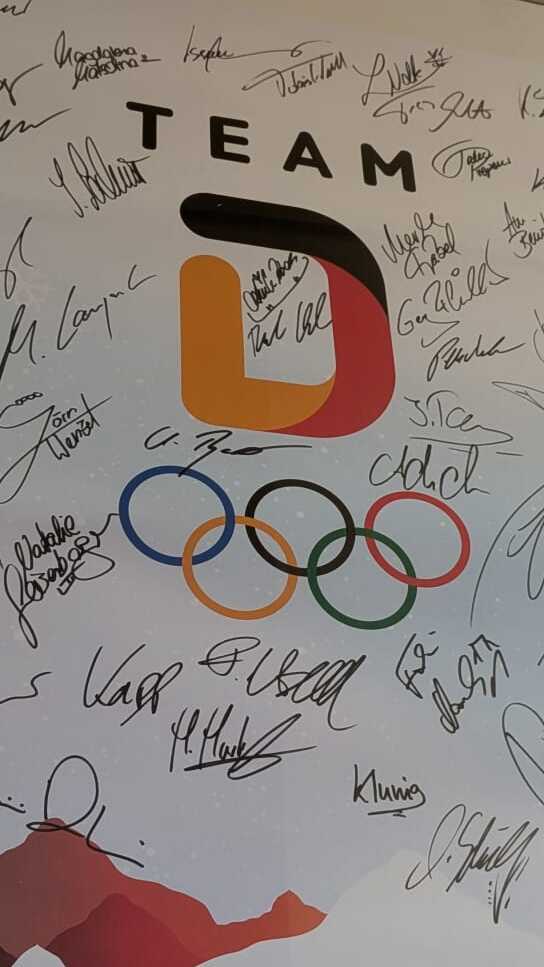
I arrived at 9am to a waiting room lined with posters from the Winter Olympic Games, with signatures on them. After passing by the front desk, my first task was a urine sample, dropped at the lab. Then came a questionnaire covering family illness history, current conditions, symptoms, nutrition, the usual intake paperwork but more thorough than anything I had filled out before.
Then it was a sequence of short visits to different rooms, to measure different things. Height, weight, body fat. Resting blood pressure and ECG (I had to take off my Garmin before starting). A lung function test in a clear booth that looked like one of those glass phone-call booths you find in coworking spaces.
Then a doctor’s consultation. We went through my family medical history, training volume, goals. I brought last year’s bloodwork on my phone and emailed it over on the spot. Another blood draw happened in that room.
The treadmill test was the main event. Electrodes glued on, cables running to a monitor on a belt, a safety harness clipped to an overhead rail, and some chili rubbed on my earlobe to make the skin easier to draw blood from during the test.
The treadmill, the biggest I have ever been on, was embedded into the floor. The protocol ran in three-minute stages: 6, 8, 10, 12, 14, 16, 18 km/h, with a fifteen second pause at each stage for an ear lactate sample and a question about perceived effort. I made it through 18 km/h before hitting exhaustion, then pushed one final minute at max effort to drive lactate as high as it would go.
They gave me a towel to clean myself up and back to the waiting room. Then the doctor called me in one last time to go through the results.
What the numbers said
Relative VO2 max came out at 55 ml/min/kg, which matches my Garmin estimate. VLaMax, a measure of glycolytic power, came in at 0.56 mmol/l/s, on the low end, which the doctor read as a strongly aerobic, fat-oxidative profile. In plain terms: built for distance rather than producing short bursts of speed. My aerobic ceiling sits at 6:02 min/km and a heart rate of 126. This, the doctor added, should be my ceiling pace for the first 100-150 km.
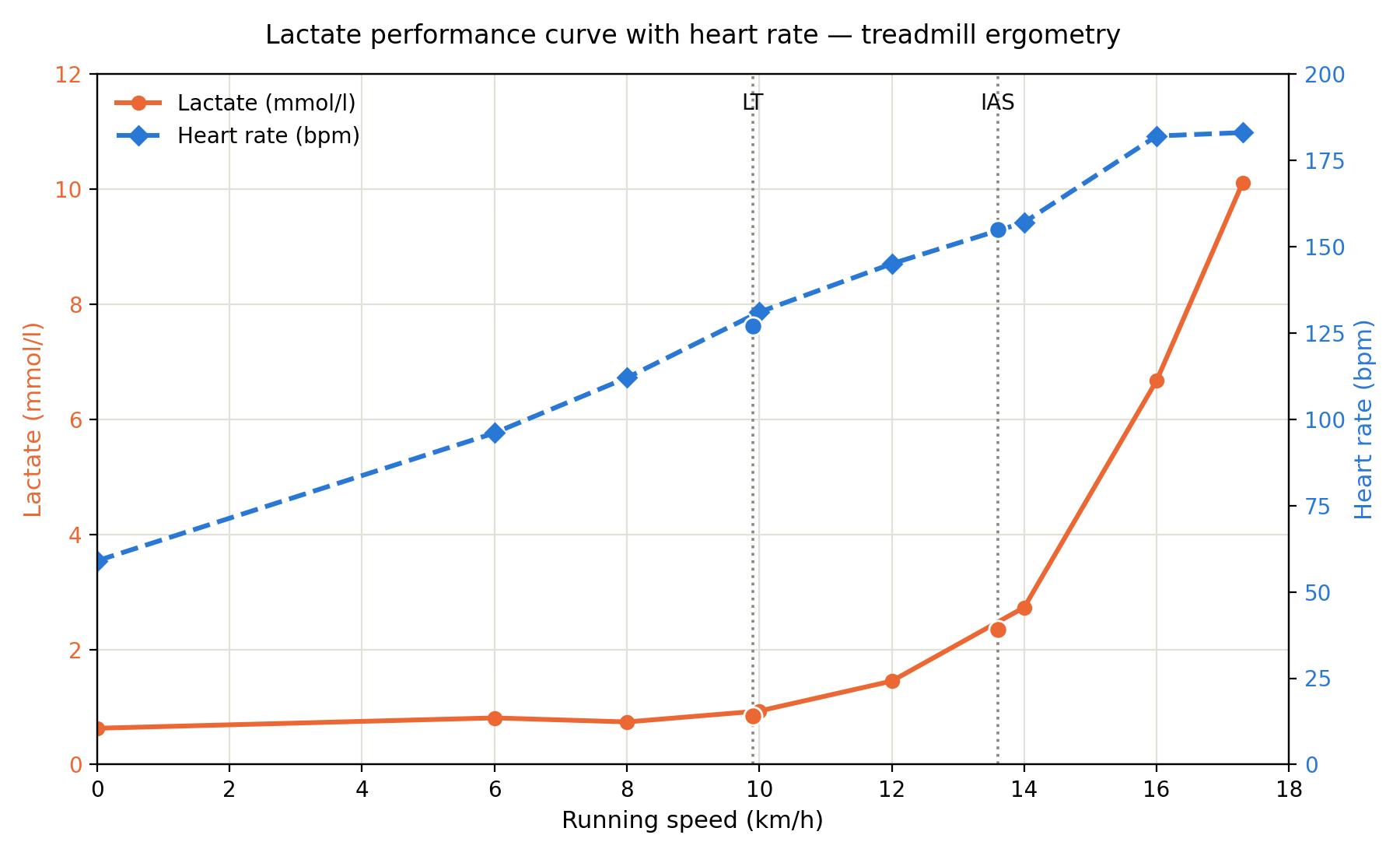
One thing surprised me. There was no mask measuring actual gas exchange during the test. VO2 max was calculated from the lactate and speed curve, not measured directly through oxygen intake. It is a detail worth knowing if you go in expecting a mask strapped to your face.
More importantly, the doctor told me my heart was doing well and that I was fit to run Spartathlon. It was the first time anyone had told me that with confidence behind it, backed by numbers. It felt good.
What changes now
I am currently doing one interval session every week. The plan now is to add a second weekly session closer to my individual anaerobic threshold pace, somewhere around 4:20 to 4:30 per kilometer at a heart rate of 150 to 158, alongside the existing 4x4 VO2 max session. On the other end, my easy runs need to stay easy, under a heart rate of 126.
Bloodwork, urinalysis and other results are still coming by mail, so there may be more to adjust once those arrive. And I am still waiting for an invoice.