
Here is some arithmetic. If I stop for 50 seconds at each aid station during the race, I will have spent over an hour of the race standing still. Fifty seconds is nothing. It is the time it takes to refill a flask, grab a cup of cola and say thank you.
That is the kind of thing you only notice when you sit down and build a pace plan. Which is what I have been doing for the past few days.
Why plan at all
Everything in this build has one objective: increasing the probability of finishing the race. Very simple. The pace plan is part of that.
I go into every race with a plan A, a plan B, and sometimes a plan C, which usually just reads “finish.” A plan gives me an expectation, and more usefully, something to aim at from one segment to the next.
In practice, the plan rarely survives. I have done better than my plan A exactly twice. Every other race turned into some version of survival, and the plan looked laughable when I read it back from the finish line.
The longer the race, the wider the gap between expectation and reality. This is no surprise. Too many things can happen over 20 or 30 hours that nobody can foresee from a spreadsheet.
I have always trained for my ultras, and I have always put my odds of finishing at 50/50. The flip of a coin. For Spartathlon, the coin looks weighted against me.
So why bother?
Because the plan is less useful as a prediction than as an excuse to study the course. Building it forces me to look deeper at the route and ask questions I had not asked before. And when reality departs from the plan, the gap itself is information.
Transgrancanaria taught me how badly I can misread terrain from a profile map. The Mauerweg taught me how much time I lose at aid stations. Both lessons came from the difference, not from the plan.
What would a good day look like
I started with three reference points.
The first is the obvious one. Spartathlon is a very difficult race, and reaching Sparta within 36 hours, while staying inside every cutoff along the way, is already a win.
The second I have mentioned before: only one other Colombian has finished this race, and his best time is 34:08:30. To go under it, I would need to reach Sparta in 34 hours.
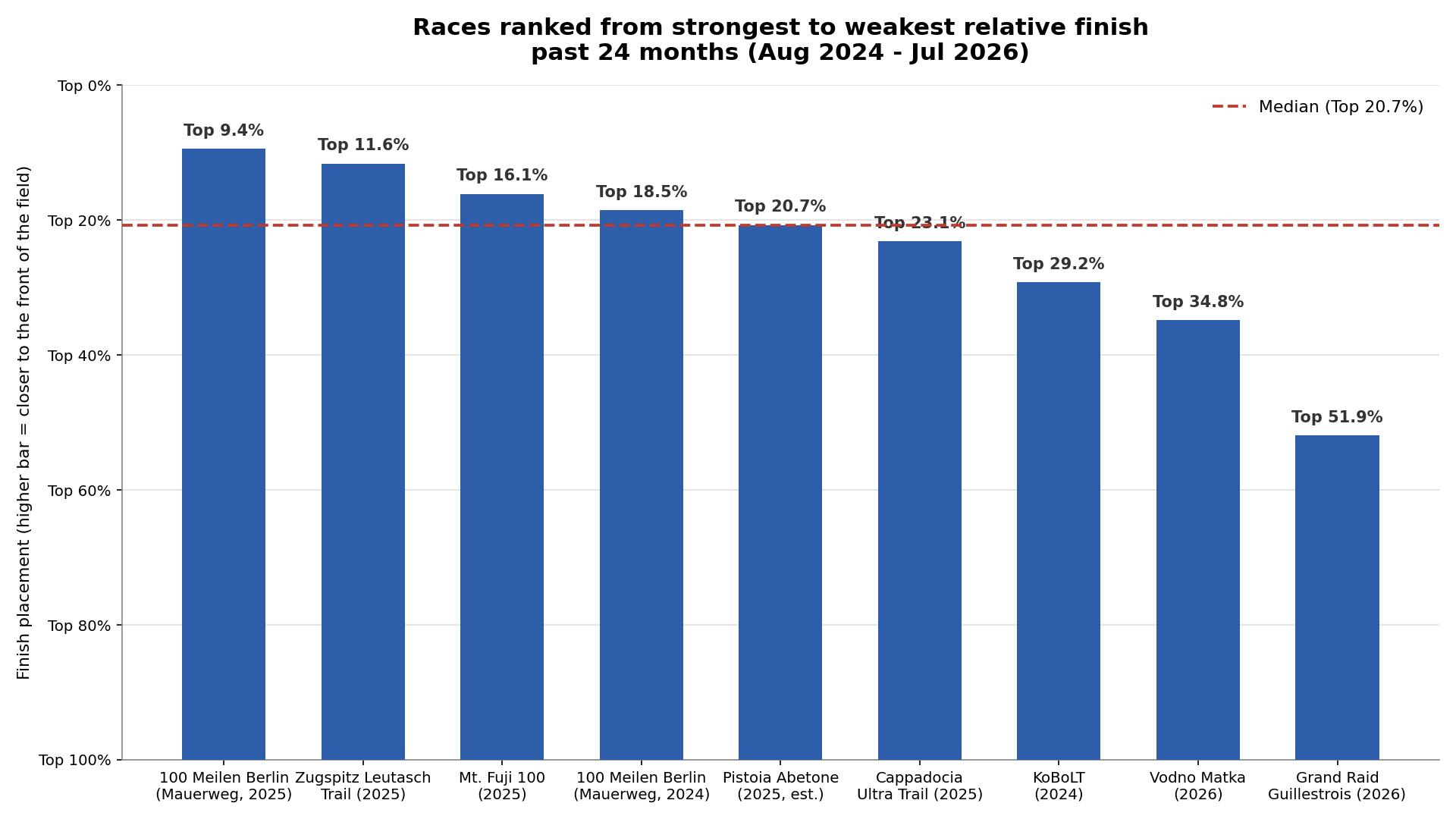
The third comes from my own history. I went through the results of my ultras from the past two years and calculated where I finished as a percentile of everyone who started, men and women combined. The median result puts me in the top 20% of the field.
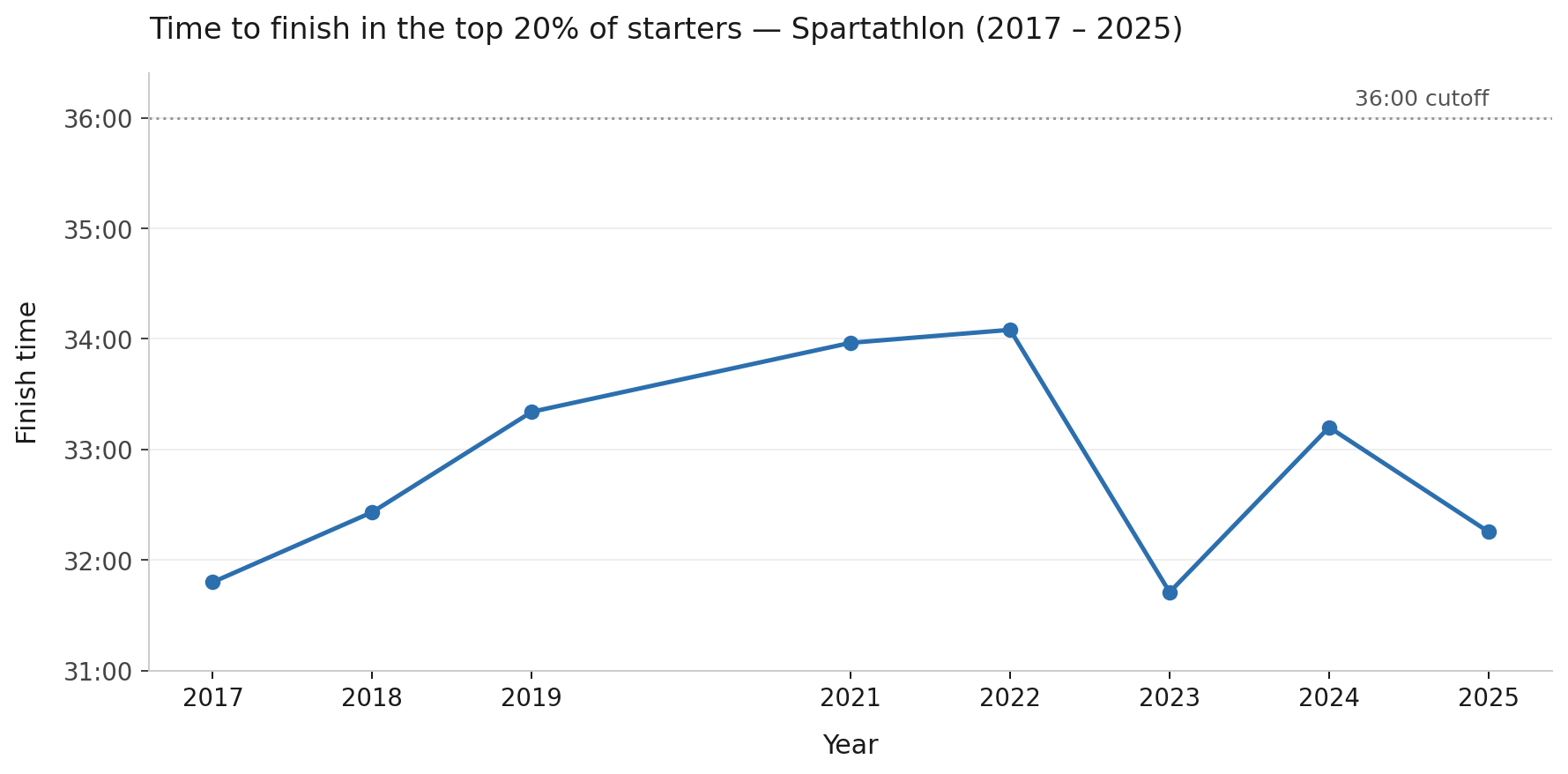
So what would a top 20% finish at Spartathlon take? With a maximum of around 400 starters, it means finishing in the top 80. I looked at the time of the 80th finisher across the last eight editions with a field of roughly that size.
But wait.
Most ultras welcome anyone who is fast enough on the registration page and willing to pay. Spartathlon only takes people who have already finished, at the very least, a hundred miler in under 21 hours.
That is a very selective pool. A biased sample, one my call it. Being in the top 20% at the races I have run says little about where I would land among people who all qualified for this one. The comparison does not hold.
Why 34 hours
Putting all of this on the table, a sensible plan A is 34 hours to Sparta, an average of 8:17 per kilometer.
It would make me the fastest Colombian on the course to this day, and I admit it, that challenge appeals to me. But the real reason is the buffer. The worst thing I could do, I feel, is run the whole race barely ahead of the cutoffs, where one bad hour ends it.
Aiming for 34 means two hours in the bank at the end. If something goes sideways, I still have room to make amends, recover and finish.
The tool says no
As I would normally do, I started by opening Garmin’s pace strategy tool. The first thing I discovered is that it has a hard ceiling at 150 miles. Spartathlon is 153. So I had to cut the course down to fit.
I set the target at 8:17 per kilometer, a positive split starting at my lactate threshold pace of 6:04, and the easiest uphill effort, since most of the climbing comes after kilometer 100.
The result did not make sense.
The Spartathlon cutoffs are front-loaded, and the tool’s splits sent me straight into cutoff territory within the first 80 kilometers. One strategy across the whole GPX is the wrong approach when the elevation is concentrated between kilometers 80 and 160.
Following the curve
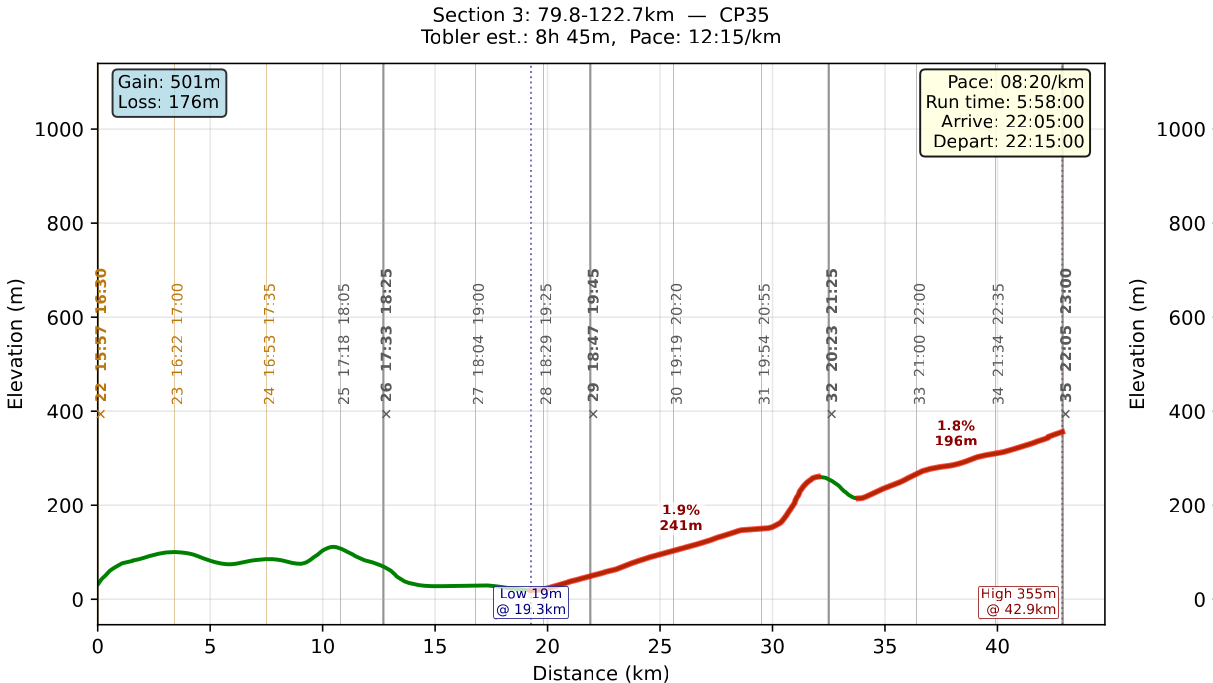
So I broke the course down. Out of 75 checkpoints, seven are major ones, where food and services are all offered and crews can meet runners. They split the race into eight segments.
Then, rather than invent my own pacing curve, I borrowed the one the organizers already drew. The cutoffs tell you how fast the race expects you to move through each segment relative to the one before it.
| Segment | km | Cutoff pace | Speed vs previous segment |
|---|---|---|---|
| Start → CP12 | 43.9 | 7:04 | - |
| CP12 → CP22 | 35.9 | 7:15 | 97.5% |
| CP22 → CP35 | 42.9 | 9:05 | 79.7% |
| CP35 → CP43 | 25.1 | 9:58 | 91.3% |
| CP43 → CP52 | 22.6 | 11:30 | 86.6% |
| CP52 → CP60 | 23.5 | 9:22 | 122.9% |
| CP60 → CP68 | 27.7 | 9:12 | 101.7% |
| CP68 → CP75 | 23.1 | 9:17 | 99.1% |
Read top to bottom, the intention is clear. The first two segments are the fastest, the next three slow down sharply through the climb, and after the mountain the expected pace picks up again and stays flat to the finish.
I then worked backwards from 34 hours, keeping the same proportions between segments and scaling everything to my target.
| Segment | 34h pace | Arrive (elapsed) | Buffer |
|---|---|---|---|
| Start → CP12 | 6:40 | 4:52 | 0:17 |
| CP12 → CP22 | 6:50 | 8:58 | 0:31 |
| CP22 → CP35 | 8:35 | 15:06 | 0:53 |
| CP35 → CP43 | 9:24 | 19:02 | 1:07 |
| CP43 → CP52 | 10:52 | 23:08 | 1:21 |
| CP52 → CP60 | 8:50 | 26:36 | 1:33 |
| CP60 → CP68 | 8:42 | 30:36 | 1:48 |
| CP68 → CP75 | 8:47 | 34:00 | 2:00 |
This is my savings plan. The buffer starts small, 17 minutes at the first major checkpoint, and grows at every one after that. No single segment asks for a heroic effort. The time is saved a little at a time.
What I carry
With a goal pace for each segment, I went back to the Garmin tool, keeping the positive split and the easy uphill effort. This time the result held together.
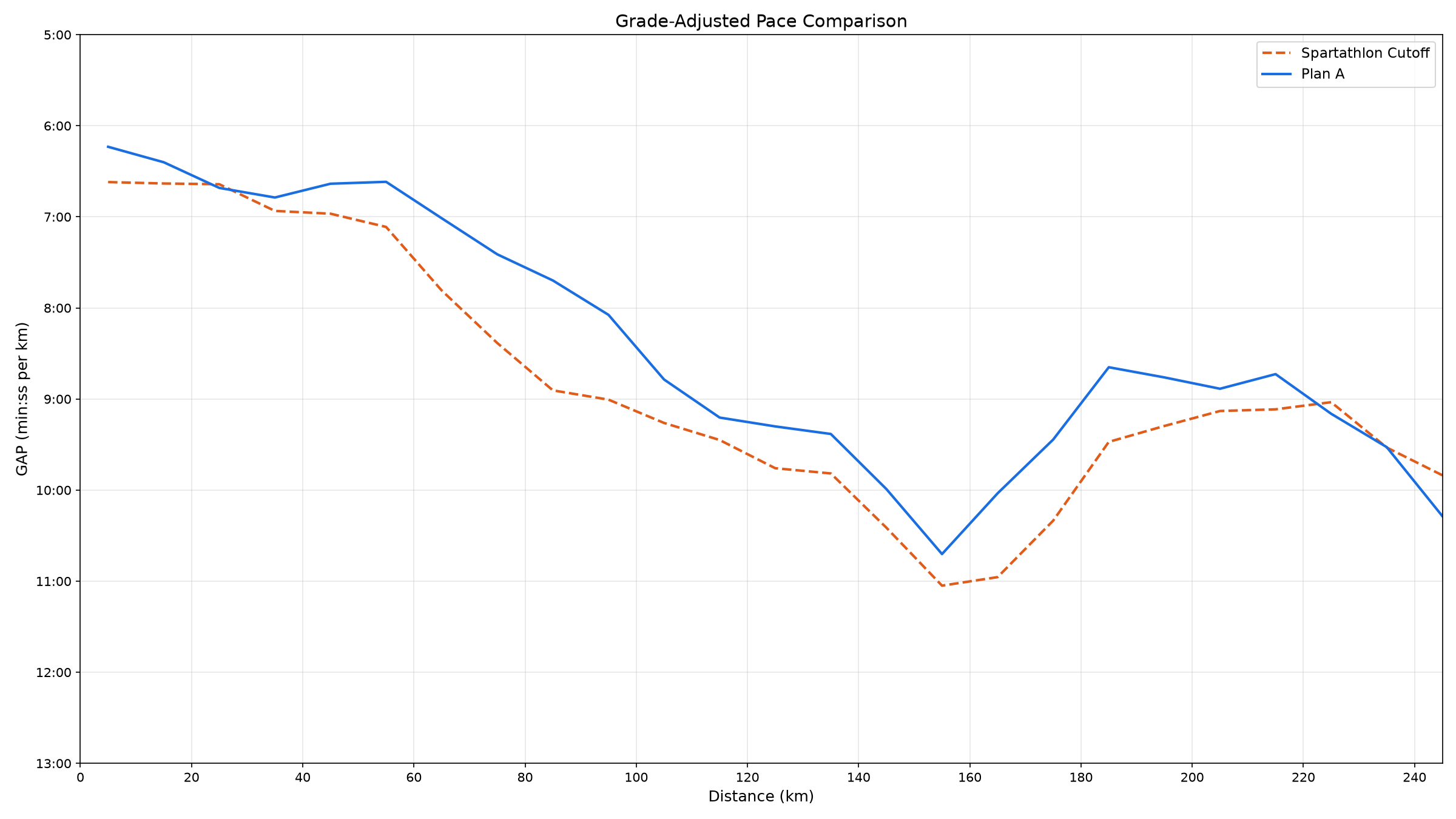
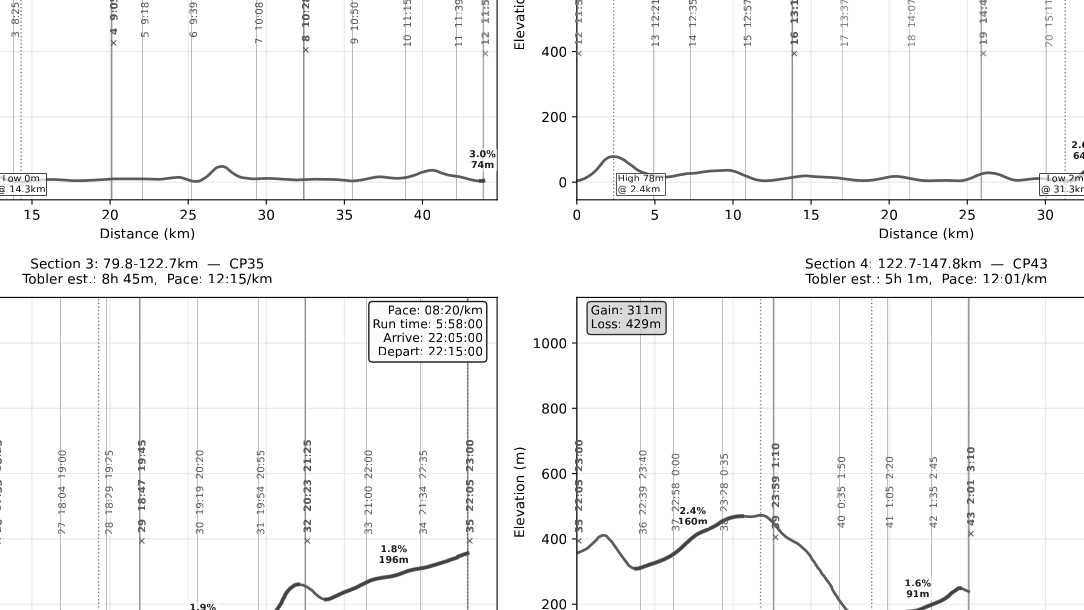
On race day I will carry a chart for each segment, with the course profile and my planned times next to the cutoff times.
What the plan does not know
This is a guide, and far from a perfect one. It does not account for the heat. It does not account for the night, which has sometimes helped my running and sometimes not. And it does not account for breaks.
In a trail race I would normally plan my stops. Here I do not find it useful. My only rules are to never stand still for more than ten minutes at a time, and to stop only at crew points and when I need to refill my flasks.
At the end of the day, it all comes down to “hope for the best, plan for the worst.”