



One of the earliest mistakes I made in ultramarathon running was staring at my watch.
Not at my pace, not at my heart rate. At the total distance. Every few minutes, I would check the number, do the math against whatever was left, and despair at how slowly it was growing. Effort going up. Distance barely moving. It is demoralizing, and I have done it more times than necessary.
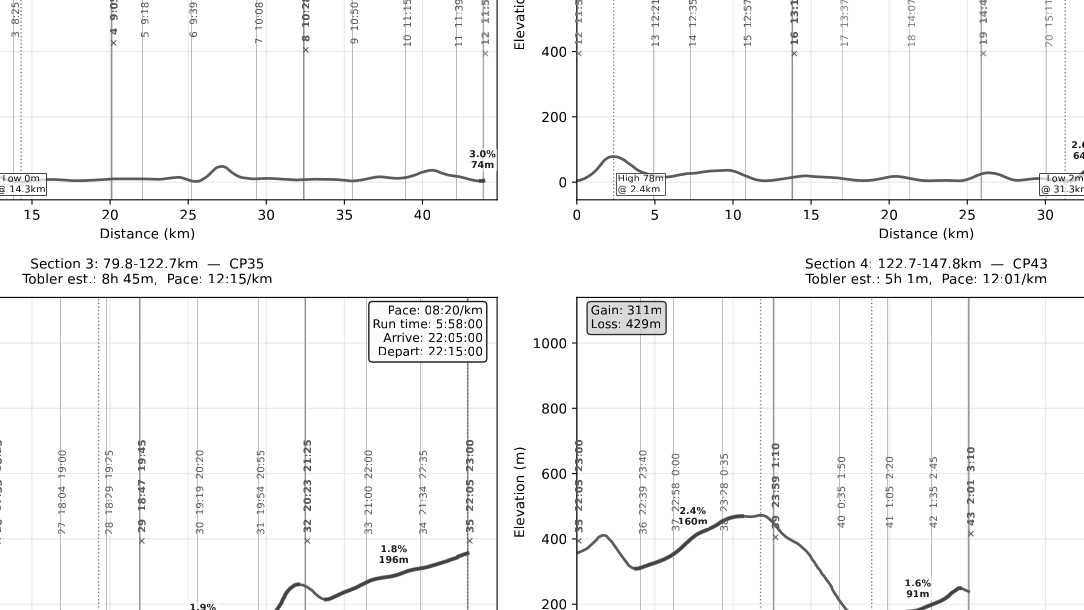
The fix was simple. I changed what my Garmin showed me. Instead of total distance, I now see the distance from the last aid station to the next. Each departure from a checkpoint starts a new lap. The watch tracks average pace for that segment, distance covered, vertical cleared. Nothing else. The full race disappears. What remains is the next 12 or 15 kilometers, which is much more manageable.
There is a mental logic to this beyond just the numbers. Dividing an ultrarace into sections means you get to finish things. Small victories, repeatedly. You leave an aid station and you are, in a real sense, starting a new race. When you arrive at the next one, you have won something. The distance between departures is short enough to hold in your head.
That has been the case until now.
Spartathlon has 75 aid stations across 246 kilometers. That’s an average of 3.5 kilometers apart, the shortest spacing I have ever run with. At first glance that sounds comfortable. In practice, it raises a question I have been sitting with for weeks: do I stop at each one?
There are two ways to see it. On one side, 75 aid stations become 75 opportunities to break rhythm. Even two minutes at each adds up to two and a half hours over the course of the race, and that is before accounting for the temptation to linger when the legs are hurting. The next aid station could always become a reasonable place to stop. On the other side, 75 stations mean almost no carrying. With support every 3.5 kilometers, a simple belt and 300 milliliters of fluid is enough. The lightest I have ever raced.
I have not resolved this yet. What I have done is look closely at what the cutoffs actually demand, and compare that to what I know I can do.
The course
Spartathlon is 245.75 kilometers with 2,726 meters of cumulative ascent and 2,613 of descent. By ultramarathon standards, it is not steep. Almost the entire route is on asphalt or paved road, with roughly 14 kilometers of non-asphalt surface concentrated near the highest point of the course, around kilometer 164 at Neochori.
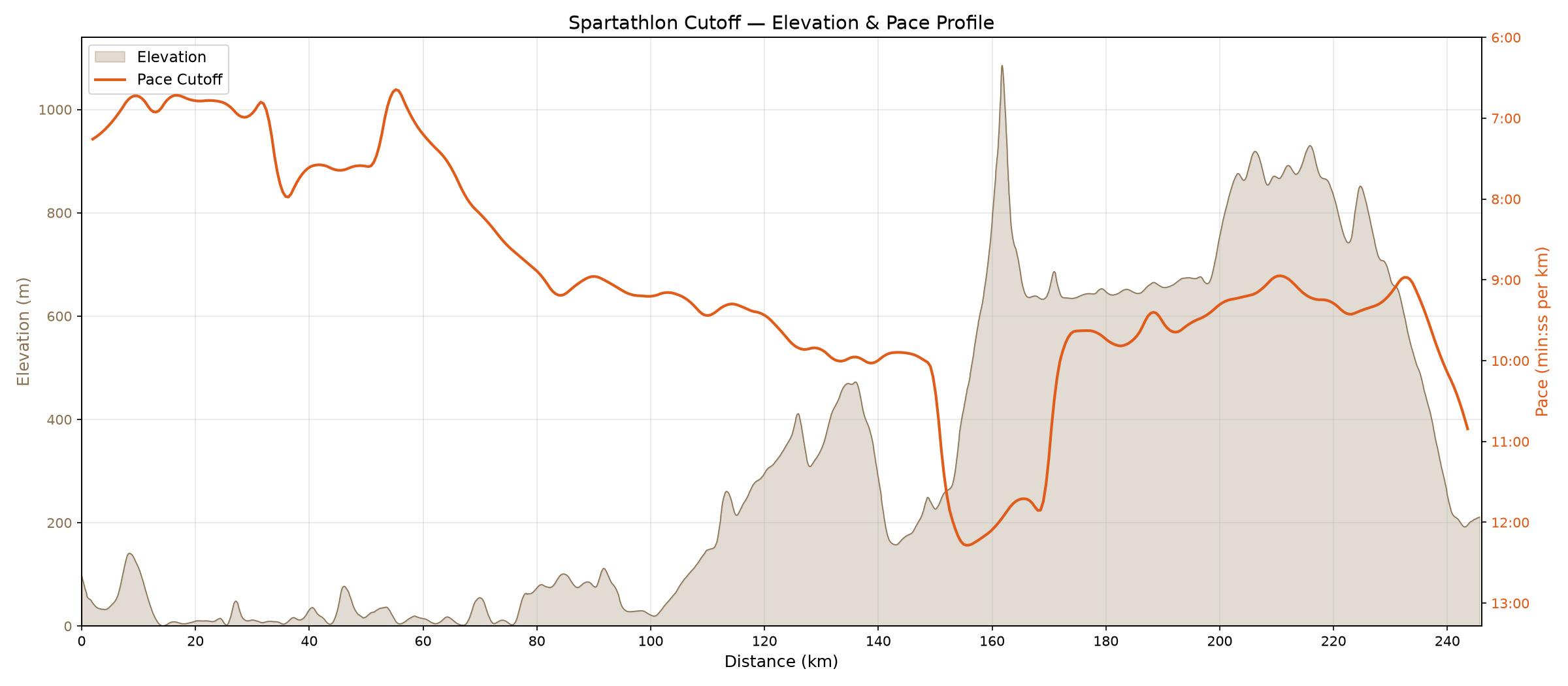
The first 100 kilometers are rolling, with the course briefly climbing into the hills before dropping toward the coast. From Corinth at kilometer 100, the course leaves the coast and gives away to the major climb toward Neochori at kilometer 164, the highest point at roughly 1,200 meters. After that, it descends to 800 meters for about 50 kilometers, later to descend into Sparta for the last 25 kilometers.
The course demands every runner makes it to the statue of king Leonidas at an average pace of 8:46 per kilometer. To guarantee this, the race imposes 75 individual cutoffs, one at every aid station (or checkpoint, as the race calls them). Miss any one of them and you are out. The cutoff pace starts relatively fast, around 6:30 to 7:00 minutes per kilometer in the opening sections, and gradually softens as the race progresses. The window widens slightly after the big climb, then tightens again in the final stretch.
What the cutoff profile reflects is that Spartathlon is not a race you can afford to run conservatively at the start and make up time later. The early pace requirements are real. If the first 100 kilometers go poorly, there is no recovery.
What I know from the Mauerweg
The comparison I keep returning to is my two Mauerweg finishes. Both are flat road races, roughly the same terrain as Spartathlon. Both are long enough to produce meaningful data on how my pace holds under fatigue.
In 2024, I crossed in 22:34:12, with 19:34:07 of moving time. In 2025, I finished in 19:45:20, with 18:05:17 moving. The difference between those two numbers is mostly aid station time. After 2024, I started tracking idle time explicitly. I simplified what I was doing at each stop, came in knowing what I needed to eat rather than figuring it out at the station, and cut the dead time by half. A year’s difference: almost three hours off the total, a little over an hour and a half off the moving time.
The grade-adjusted pace comparison against the Spartathlon cutoff makes the picture clearer.
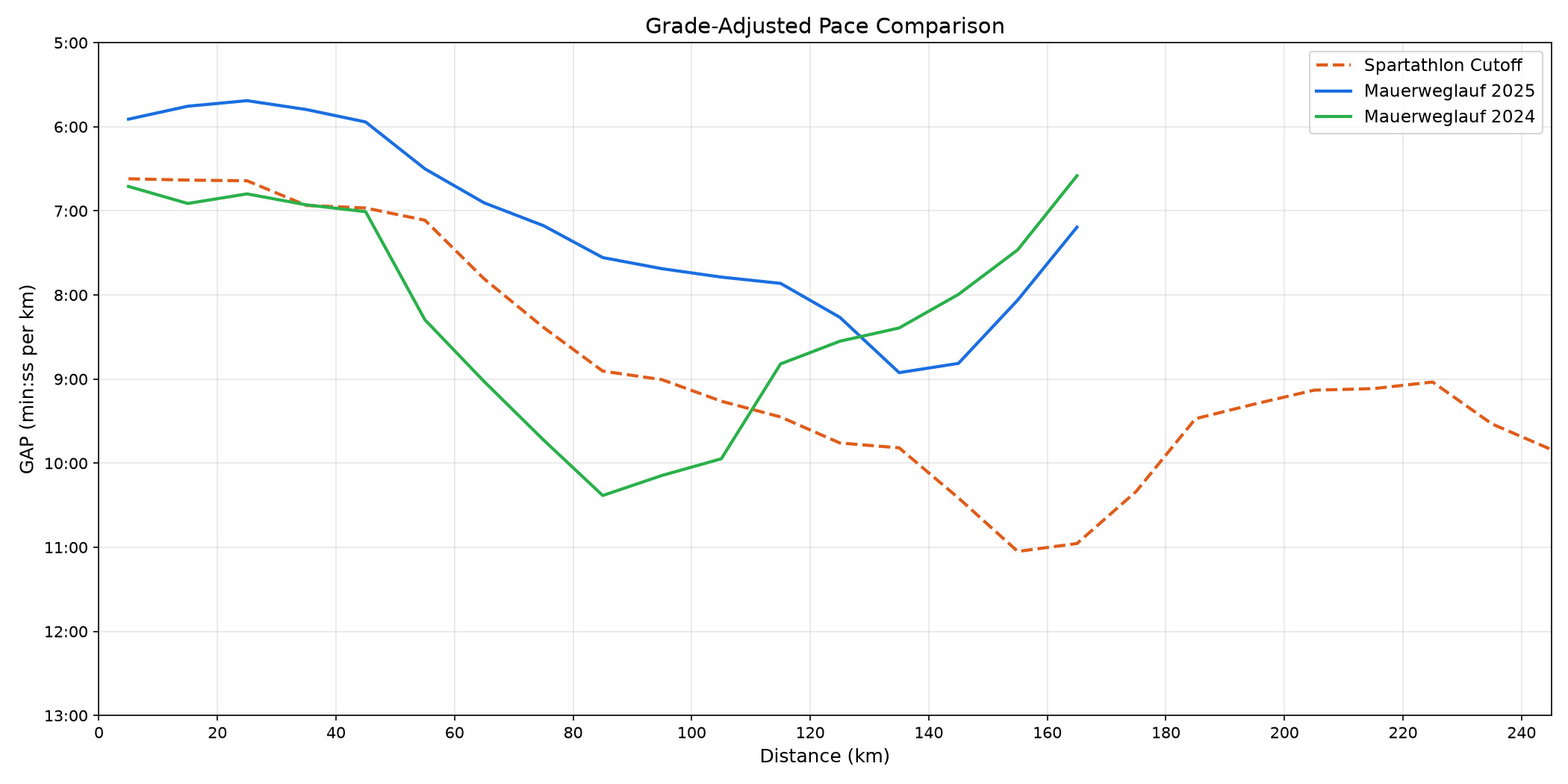
In 2024, my pace collapsed in the middle section, dropping to around 10:30 per kilometer GAP by kilometer 85. The heat was partly responsible. That was the point in the day when temperatures rose. By kilometer 160, I had recovered to around 8:30, which suggests the slowdown was a rough patch I could run through rather than a ceiling I was hitting. But the damage to the overall time had already been done.
In 2025, the slow-down was planned and more controlled. My pace stayed roughly below 8:00 GAP by kilometer 100 and held more steadily through the back half. A mild day in August helped significantly. I know that, and I try not to use it as a reason for optimism about Greece in September.
The Spartathlon cutoff line sits above my 2024 Mauerweg and below my 2025 Mauerweg. Which means, I would have been moving ahead of the cutoff during that section in the latter effort. After kilometer 160, the cutoff pace drops to its lowest point, around 11:00 per kilometer, and then stabilizes.
The first 100 kilometers are everything
The single observation that has stayed with me most from studying this course is how much the early sections determine the outcome.
Every account I have read, every conversation with people who have run Spartathlon, leads to the same place: if the first 100 kilometers are controlled, there is a chance. If they are not, there is not. Not because the back half is technically harder, but because you cannot manufacture time that you have already spent. The cutoffs are so that you need to build a buffer in the opening sections. There is no late-race heroics version of finishing this race.
My 2025 Mauerweg performance suggests I can hold a pace that meets the Spartathlon cutoff through most of the distance. What I do not know is the total effect of the heat. September in the Mediterranean is not August in Berlin. I ran the 2024 Mauerweg in heat and I know what happened. That is the version of events I need to prepare for, not the one that went well.
The median Spartathlon finisher crosses in 33:58:00. The only other Colombian to have started this race finished in 34:08:30. Those two numbers sit in my head as a reference point, but the honest goal is simpler than a time: finish within 36 hours. Everything else is secondary.
I will be checking my watch after all. Not so much for pace or elevation. But simply for time. Am I inside the cutoff? If yes, eat quickly, refill, and keep moving. That is the whole strategy. Everything this summer is in service of making sure the answer stays yes.