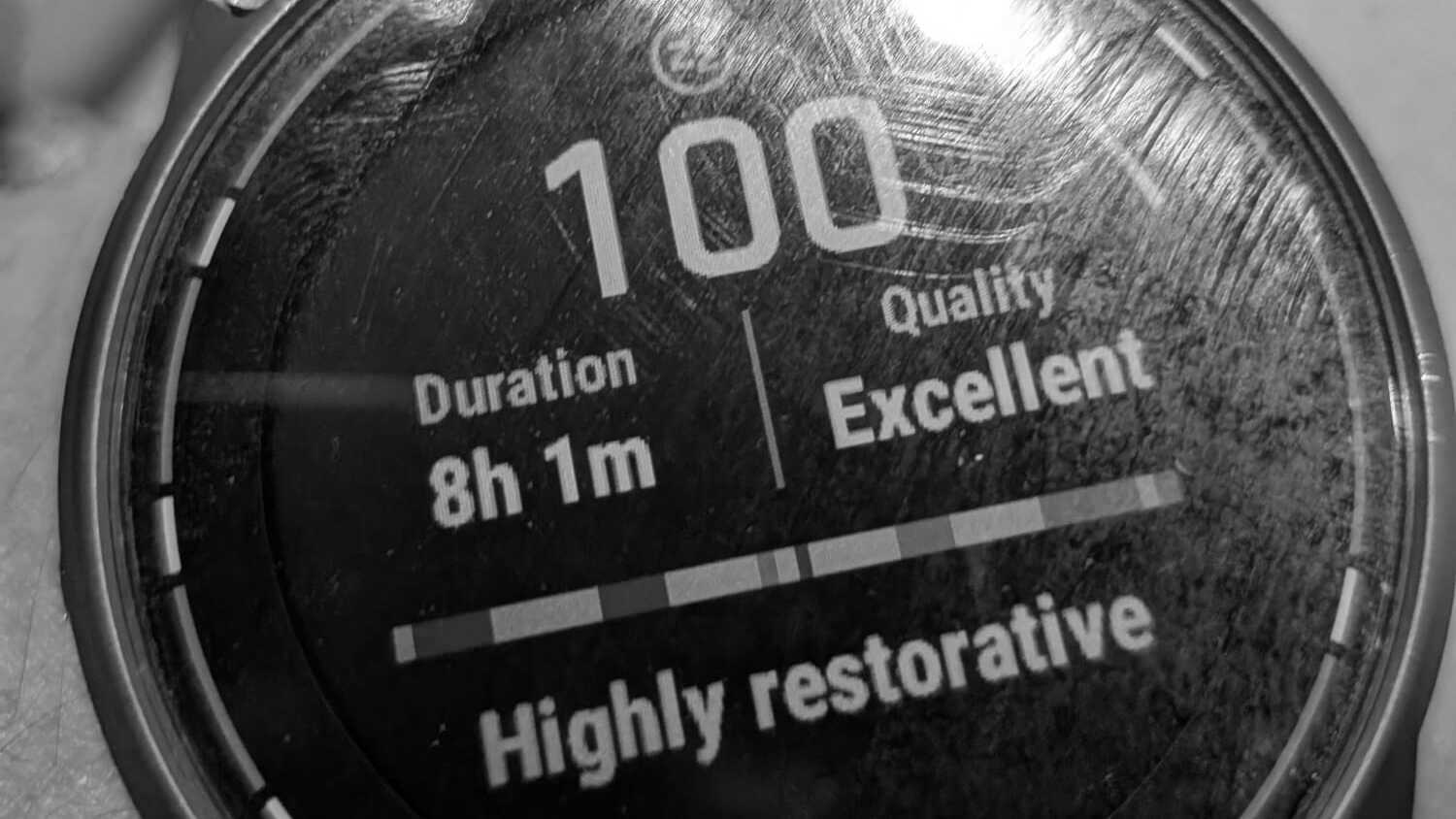


Back in May I wrote about the training plan and about what peak week is for. The idea is that the biggest week of the build should match the race in volume and in character, so that race day is not the first time the body sees anything close to it.
On paper, week 35 was 245 kilometers and 2,000 meters of ascent, with a short line of notes beside it. Monday rest, Tuesday and Wednesday around 42 easy, Thursday 60 hard, Friday to Sunday around 35 easy.
That line said nothing about where the VO2 max session goes, or the tempo run, or how you find 2,000 meters of elevation in Berlin, or when the strength work and the sauna happen, or how you rehearse eating race food while you are at it.
Those questions followed me around for most of the block. A good share of my long runs this summer were spent rearranging this one week in my head.
Building the week backwards
I started from the sessions that could not move, and let the rest fill in around them.
Sunday was trail with my group, which meant roughly 20 kilometers and 200 meters of gain, and a fixed meeting time. Saturday was the long run, longer than 80 kilometers, because I wanted another cutoff simulation after what happened at the Mauerweg relay, and Saturday was the only day with eight or more uninterrupted hours in it.
Tuesday was the VO2 max session, 11 kilometers, on the freshest legs of the week. The tempo run, another 14 kilometers, had to sit far enough away from Tuesday to be worth doing.
Then the elevation. My two reliable sessions are hill repeats at Teufelsberg and loops at Volkspark Prenzlauer Berg, about 55 kilometers and 2,000 meters between them. Both are hard, so neither could share a day with the intervals. That put them midweek and Friday.
Everything left over became easy distance, spread as evenly as I could manage, with one rule: arrive at Saturday as fresh as a week like this allows.
Monday was rest, light band work and a sauna session.
| Day | Session | Notes |
|---|---|---|
| Mon | Rest | Bands, sauna |
| Tue | VO2 max 11 km + easy | Track in the morning, Spree in the evening |
| Wed | Teufelsberg hill repeats + easy | Hill repeats on the paved side, bootcamp run at night |
| Thu | Tempo 14 km + easy | Track again, same shape as Tuesday |
| Fri | Volkspark loops, 27 km, +1,000 m | The hardest session of the week that was not Saturday |
| Sat | Ringbahn, 86 km | Cutoff simulation, full race fuel |
| Sun | Trail, 20 km | Group run |
When week starts on the wrong foot
The first thing to break was the easiest thing in the week. The sauna at the place I normally use was out of service on Monday. So I had to find an alternative. A small thing, but it set the tone for the week.
I was also going into a number I had never seen. I know what a 170-kilometer week feels like in the legs and in the rest of my life. 250 was uncharted. The weather at least cooperated, mild by this summer’s standards, mid to high twenties all week.
Tuesday morning I had to work harder than I wanted to hit VO2 max pace, but it went. In the evening I went back to a route I used during the build for my first hundred miler, through Treptower Park and along the Spree. I had not run it in a long time. It turned out to be a good way to put easy kilometers on a day that had already been hard.
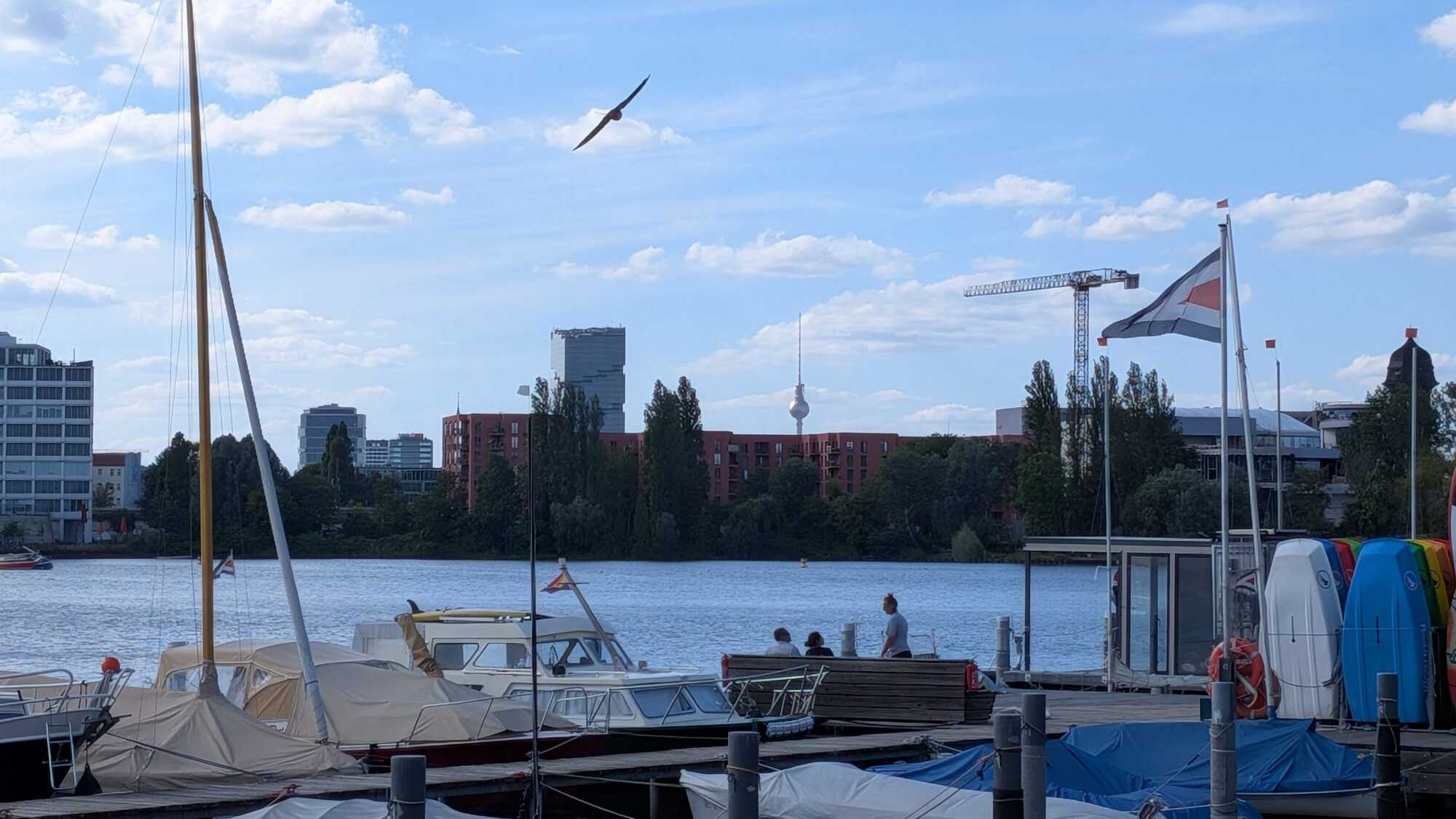
Wednesday was hill repeats at Teufelsberg in the morning and the Midnight Runners bootcamp at night, with the run to and from the meeting point turning a social session into another easy block. Thursday was a copy of Tuesday with a tempo run in place of the intervals. Living 500 meters from a track is the single biggest logistical advantage I have.
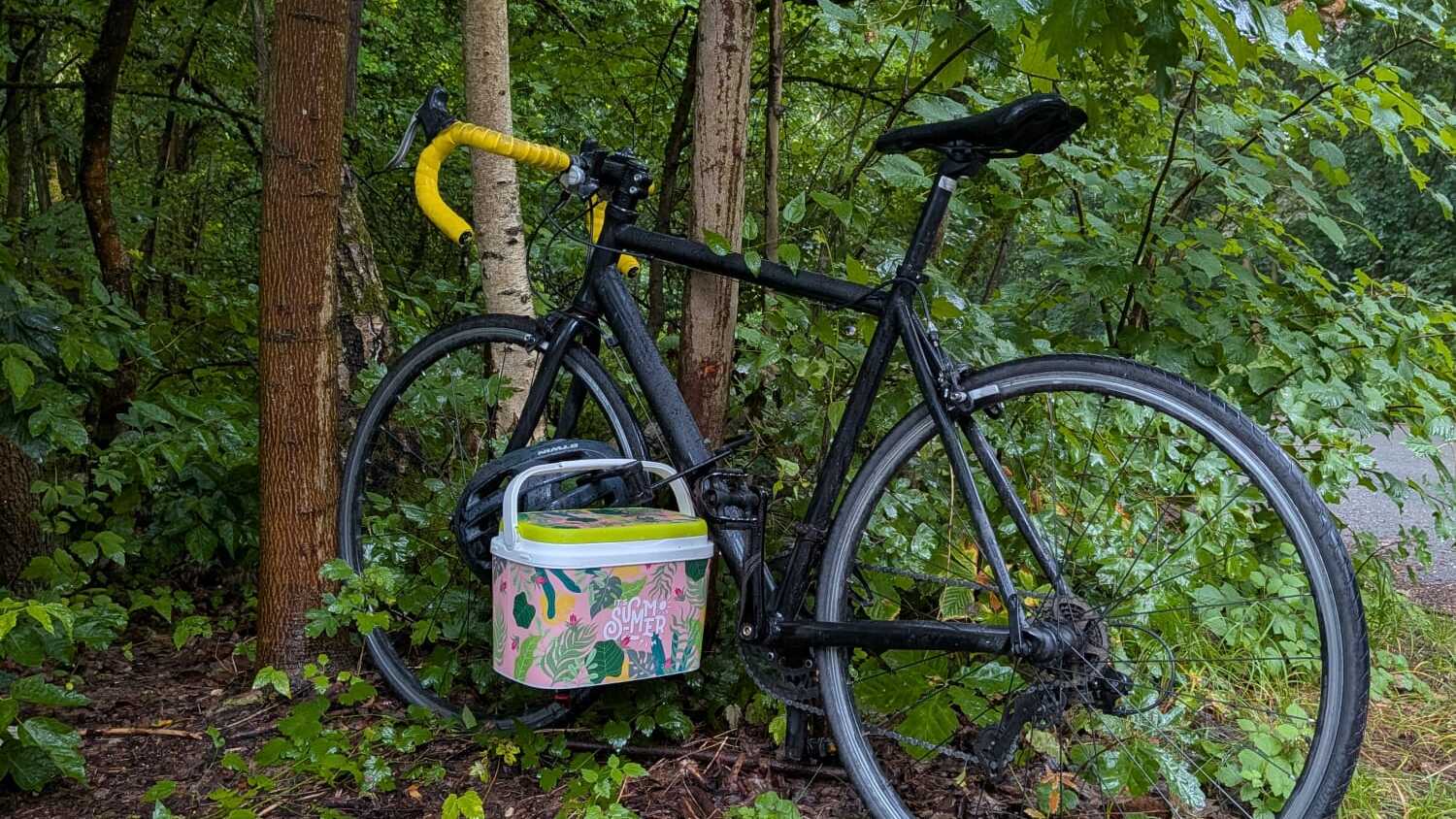
Friday was the one that hurt. Volkspark Prenzlauer Berg is convenient for Berlin standards. It has elevation, has some trail, and is all inside the city. It is also run down and largely empty, with nothing to look at, which I suspect is why so few people bother with it.
Twenty-seven kilometers and a bit over 1,000 meters of climbing, alone, on loops. Finishing that session was the happiest I felt all week.
Where do you run 80+ kilometers
By Friday evening I still had not answered the obvious question.
The first option was a section of the Mauerweg, which I have used for long runs before. The problem is food. I wanted to eat exactly what I will eat in Greece, and there is nowhere to stage solid food out there. I would be back to improvising from petrol stations.
The second was the track. I did 60 kilometers there last year while building for the Mauerweg, with a cooler set up beside me, which solves the fuel problem completely. It was also boring beyond description, and it only worked because I kept switching direction using the skating ring on the inside. On a busy Saturday that is either impossible or exhausting, and it looks nothing like a race.
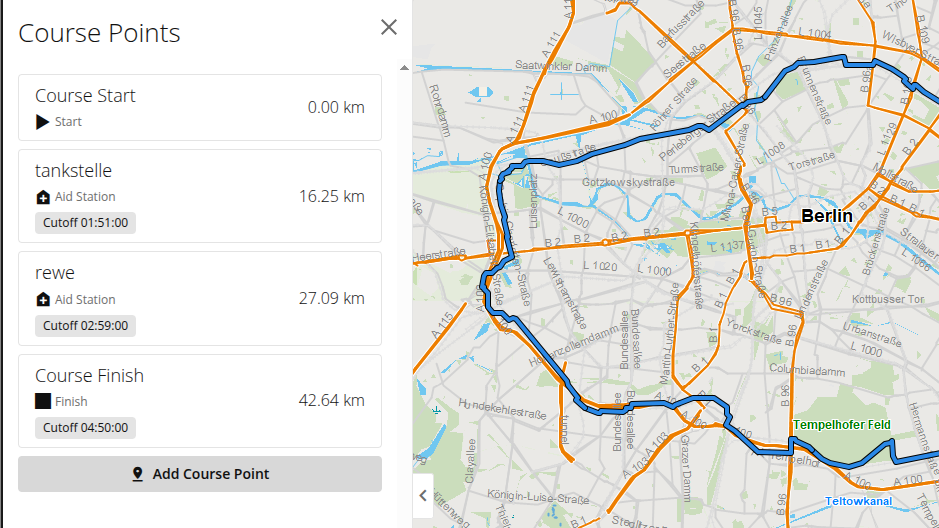
Then I remembered the Ringbahn. I ran its length once, about two years ago, and it came out close to a marathon. It starts near my flat, which meant I could leave the food at home and come back through at kilometer 42, eat there, and treat it as the first checkpoint where I meet my crew.
It sends you through the middle of a city with live traffic in it, which the Mauerweg does not. Spartathlon is run on open roads, which is the whole reason headphones are banned. Two loops of the Ringbahn was the closest thing to that I could build from my own front door.
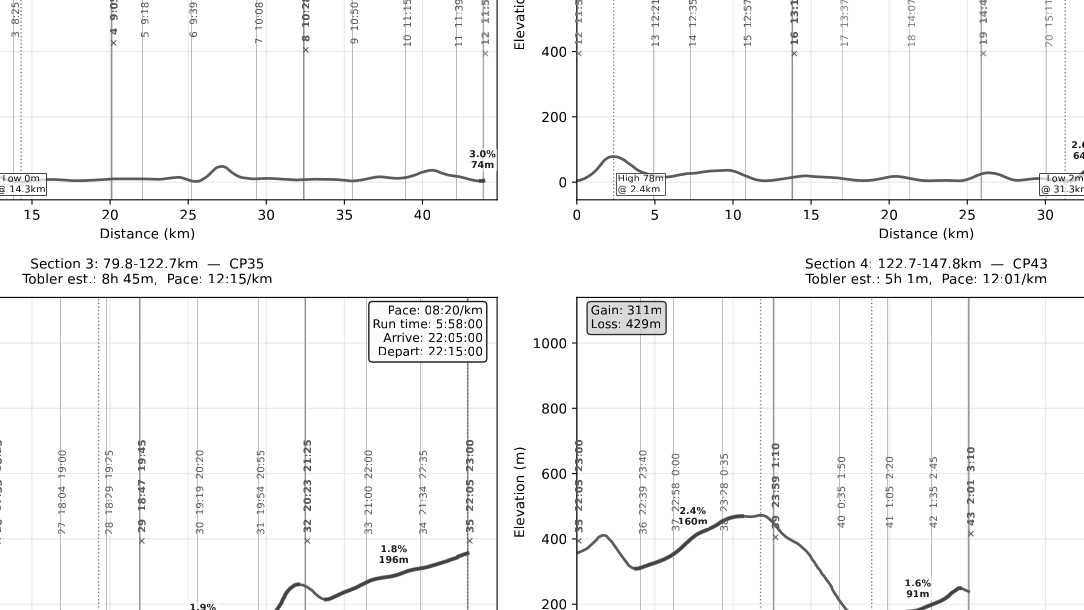
I pulled the old GPX, set course points at the petrol stations and supermarkets where I would stop, and loaded cutoff times into each one. The plan was to run the second loop in reverse, but Strava kept rewriting the route every time I used the reverse function, so I settled for the same loop twice.
Nine and a half hours in the city
Five kilometers in I ran into a group of friends going the other way. “Wrong direction,” one of them shouted. If they only knew.
For a long stretch the only things in my head were navigation and the ETA to the next course point. Traffic lights became eternal. I would watch the estimate climb while I stood there, then spend the next kilometer nudging it back down.
Hermannstraße and Gesundbrunnen were a constant business of dodging people. Tempelhofer Feld and the long stretch between Charlottenburg and Westhafen were the reward for it.
After the first loop I came home, ate the mashed potatoes, rice balls and pasta I intend to carry in Greece, refilled the flasks and went back out inside my own simulated cutoff. Only then did it occur to me that I was about to cross 200 kilometers for the week and still felt fine. Tired, yes. But intact, and still willing.
The night came in, the temperature dropped, the headlamp went on for the last stretch, and I got home nine and a half hours after leaving. A total of 86 kilometers run, and every checkpoint made ahead of the cutoff times.
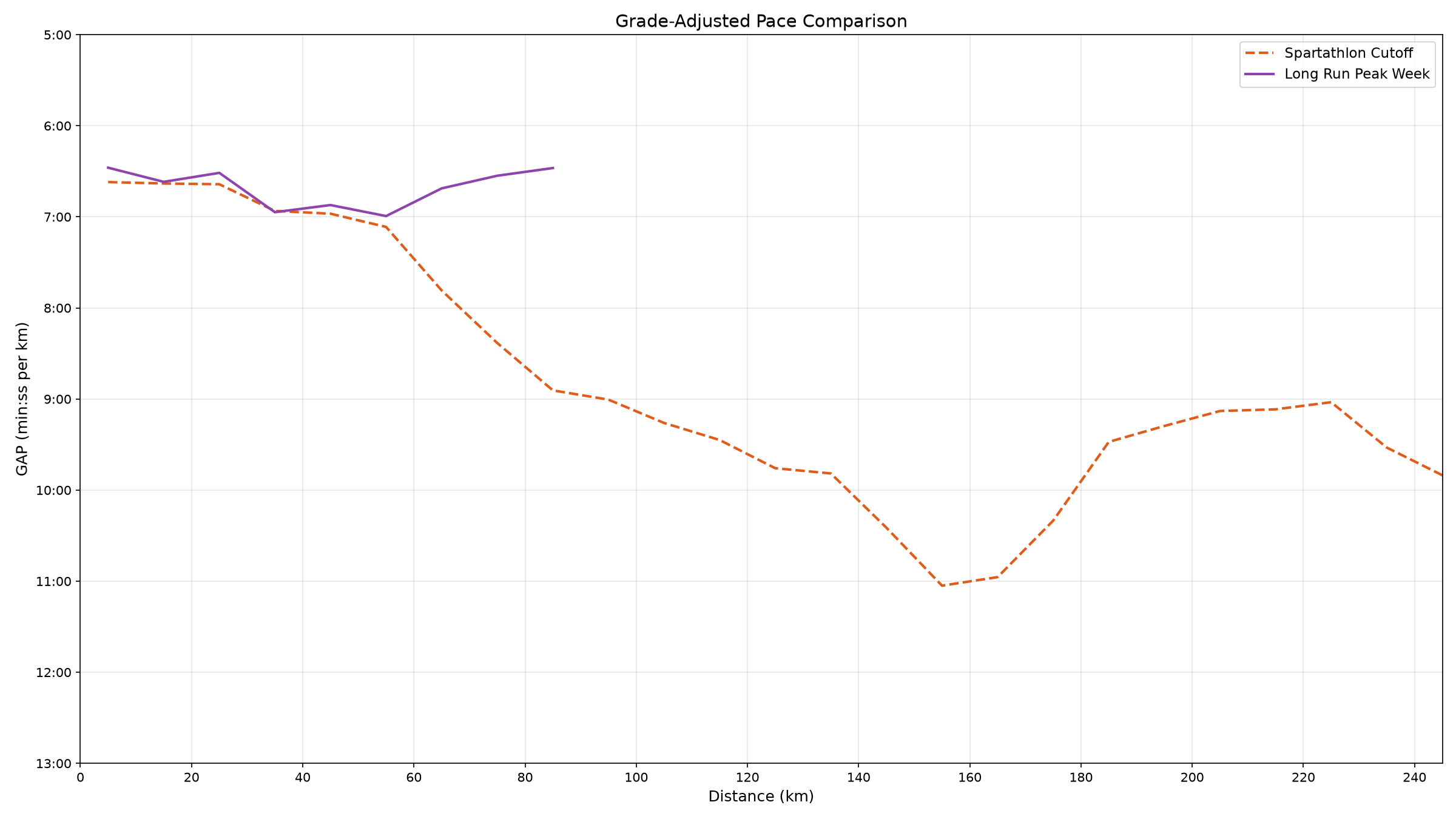
I knew I could have kept going. That craving for more distance at the end of a long effort is a feeling I have had a few times in this sport and never on demand. It showed up that night.
Sunday, and the penguin
The first steps on Sunday morning were worse than anything the whole training block had produced. Getting the trail shoes on took effort. Stairs were a battle.
A side note. After two months of this, friends and now strangers at the spinning class have started telling me I am not walking correctly. The word used most often is penguin. I have been advised, more than once, to get that looked at.
I went anyway, on the theory that ten people chatting would carry me through the first kilometers, and that the worst case was turning around and walking back to the meeting point. I started at the back of the group and within a couple of kilometers I was holding pace. Twenty kilometers later I was still there, which I would not have believed at breakfast.
What it came to
252 kilometers, 27 hours of running, 3,300 meters of ascent.
Whatever happens in Greece, this week is already a thing I did not know I could do. Not the distance on its own, but the distance alongside a life. That was the part I was least sure about in May.
The hardest week of the plan is behind me. From here it is three weeks of taper and then Athens.