I left Zevgolatio at the 100-kilometer mark, 13 minutes behind Plan A, still in a good mood from seven kilometers with the dog. Ahead were the night, the mountain, and most of the climbing in the race.
One climb
The first sustained climb of the course started as the day ended. I felt good. I slowed down and kept jogging, steady, the way I had planned it.
Somewhere on that climb I first noticed the name Yousuke on a bib. I remember it because one of my favorite DJs, Yousuke Yukimatsu. Yousuke the runner and I kept passing each other all the way up to CP32, and, as it turned out, all the way to Sparta. We never exchanged a word.
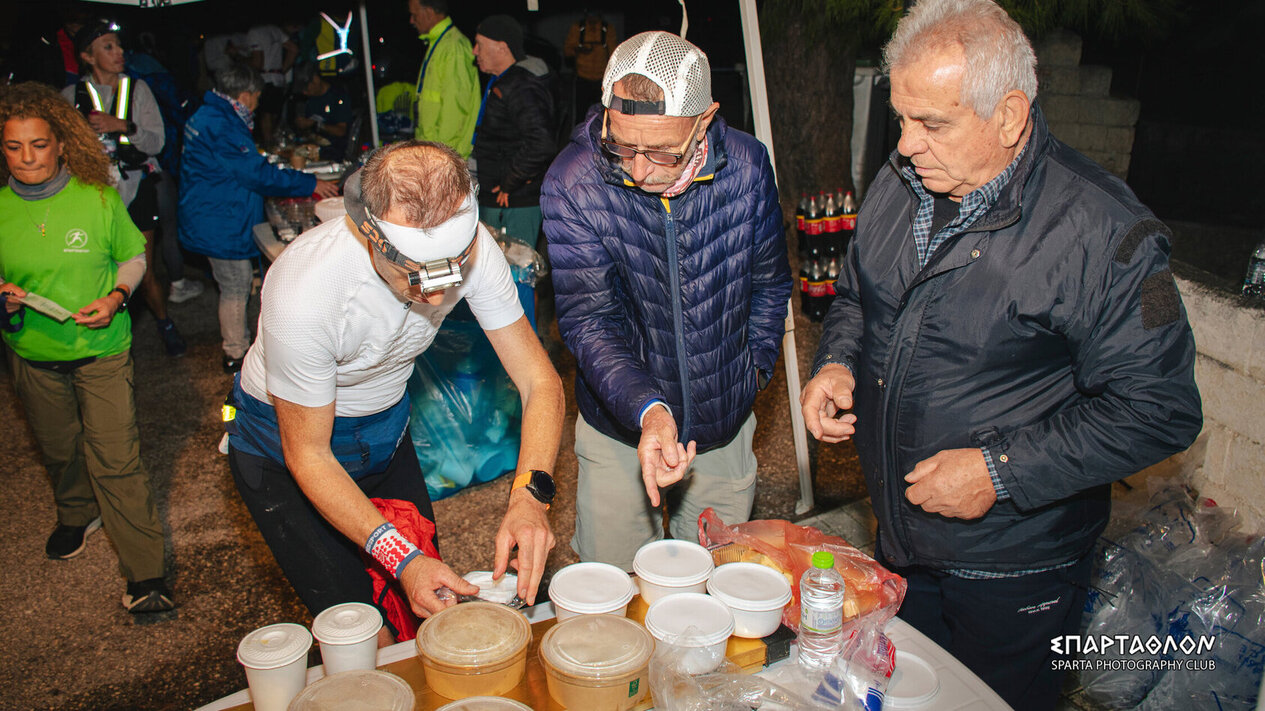
At CP32 in Halkeion, kilometer 112, runners were sitting down to dinner. Others were getting massages. I wanted to keep my rhythm, so Lefteris and I swapped flasks and I left.
Then the night came, and with it a lesson about GPX files. What had looked like one long, steady climb on the elevation profile was really a series of ups and downs that only averaged out to a climb. On one of those rises, for the first time in the race, I walked because I was tired. Not because the plan said so. I let it happen. Most of the elevation was still ahead, and I would need whatever I saved.
You are not eating enough
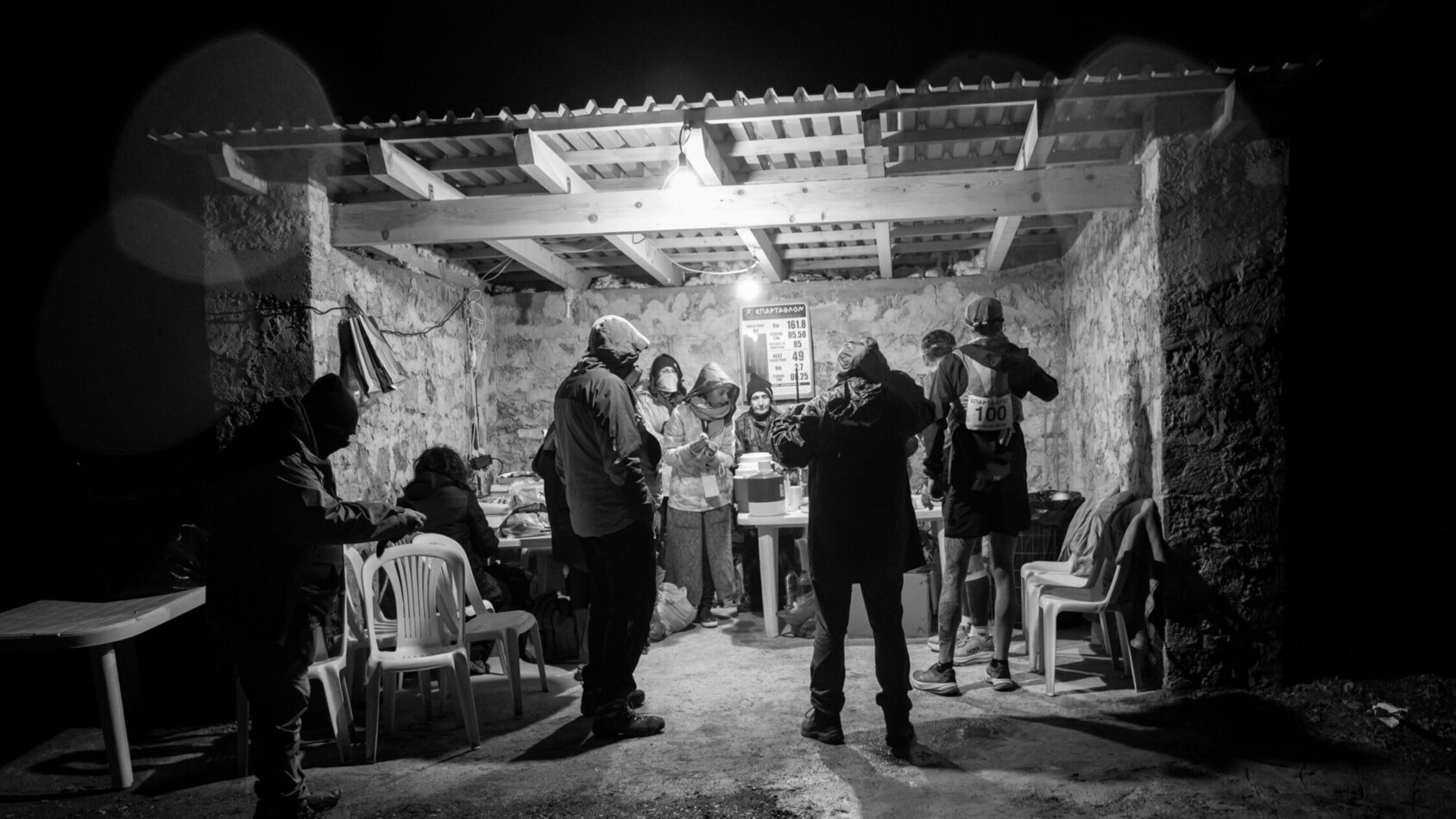
At CP35 in Ancient Nemea, kilometer 122, Lefteris was there waiting for me. You are not eating enough, he said. I need it to fix that, otherwise it would cost me later. He brought chicken soup, and it went down without a problem.
The uneven climb continued. Past midnight I reached what seemed to be its highest point, at CP39, where I expected Lefteris with water. He was not there. I called him. Are you already here? he asked. He told me to keep going and he would find me.
The descent started, and I could not make use of it. I would run, then walk, looking for his car. He called again. He was at CP40. I had got the meeting point wrong. It meant four kilometers without water, which on a chilly night was no big deal. But it was the first sign that my judgment was starting to slip.
Asleep on the move
I remember little of the road to the next major checkpoint. I was falling asleep while running. I would jog with my eyes closed, counting how long I could hold it, until I opened them in a quick panic to check I was still on the road. Ahead, the outlines of mountains, some much higher than others. Is that where I am heading?
Then I caught up with Chris, the runner from New York who had called out “nice pace” during my sprint to CP13. We had crossed paths four times since, trading a little information each time. This was the fifth and last. We ran together for a while. He knew Camilo, the other Colombian to have finished Spartathlon, since they both live in Manhattan. This was his fourth Spartathlon, and he had finished the previous three. He had never seen it this cold.
Then he told me about the Sangas pass. He did not understand why people talked about it like Everest. It is the highest point of the course, he said, but not that high, especially by trail standards. They give you plenty of time to clear it. And once you clear it, you can be sure you will make it to Sparta.
It was one of the few moments in the whole race when I thought about the finish line.
He told me to go ahead, he would walk a bit. I heard the hauling of jackals in the dark, on the way into Lyrkeia.
Ten minutes
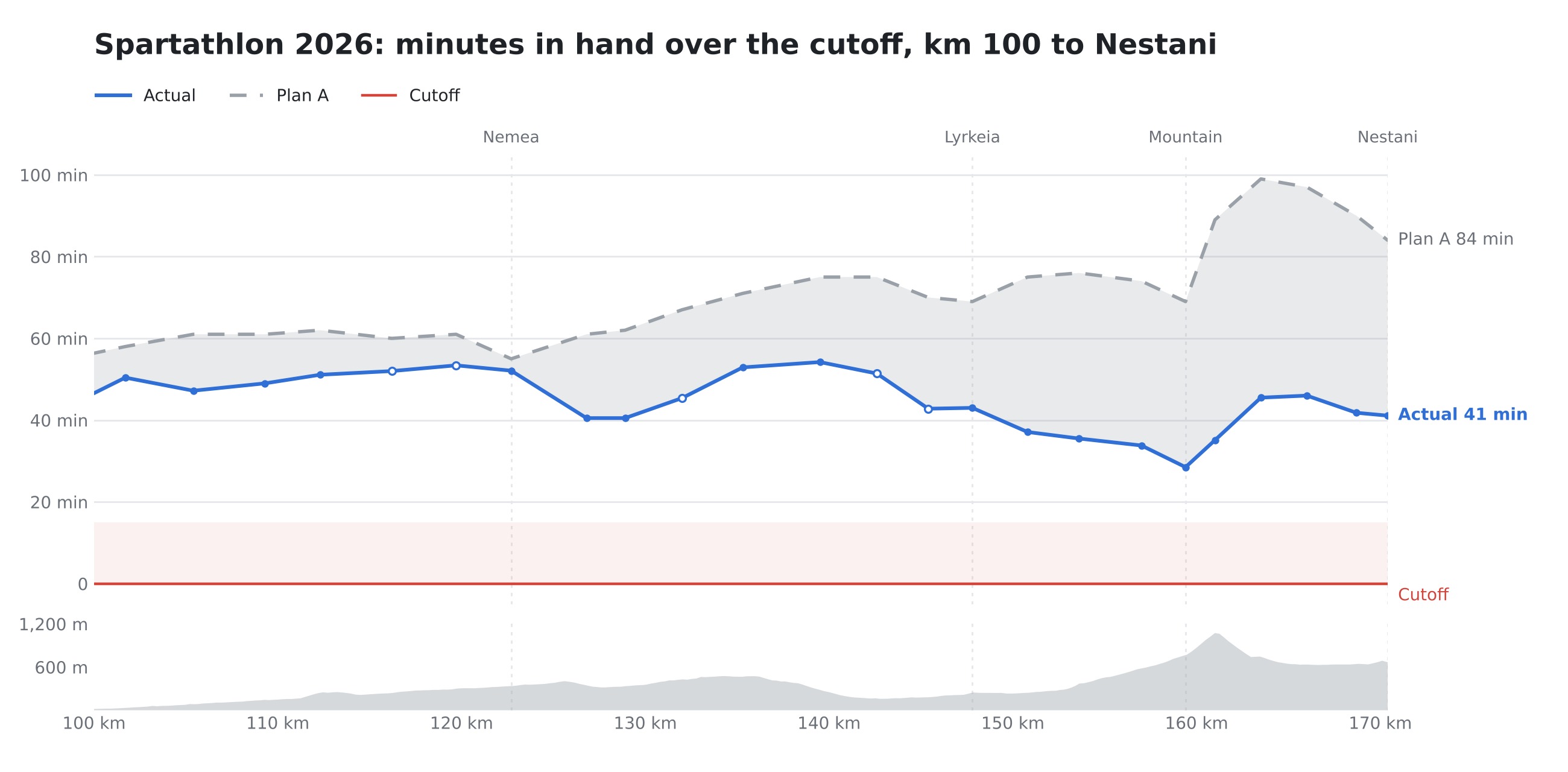
I reached CP43, kilometer 147, at 02:20. Twenty minutes behind Plan A, 50 minutes ahead of the cutoff.
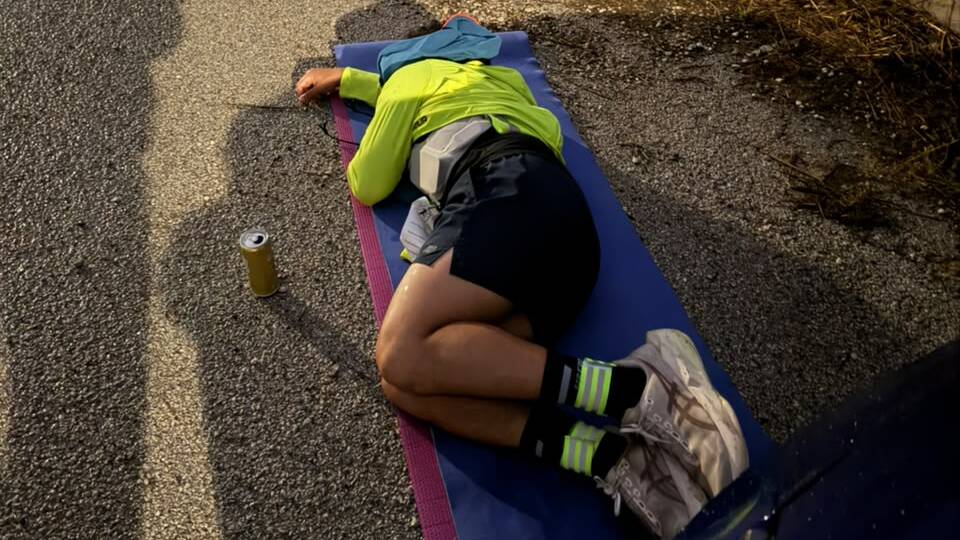
I need to sleep, I told Lefteris. The biggest climb and the only trail section of the race were next, and I could not afford to take them half awake. Runners are not allowed inside their crew’s vehicle at any point, so he laid two yoga mats on the ground in front of the car. I drank half a can of Club Mate, lay down, pulled my jacket over me, and asked for ten minutes. I fell asleep to the footsteps and voices of runners leaving the checkpoint.
When he woke me, I felt revitalized. We swapped flasks, I took the rest of the Club Mate, and I left. Into Mordor, I decided to call it. It felt appropriate. A thousand meters of climbing stood between me and the top.
The mountain
The road steepened and I went straight to power hiking. Plenty of runners passed me. I would rather move steadily than push now and stop a few kilometers later. A Hungarian runner asked if he could tag along. Not a problem, I said. We climbed most of the paved road to the base together, and before long we were passing the runners who had overtaken me, now stopped halfway up. Years of trail running were paying off. Above us, a line of headlamps went up the mountain. It looked steep.
At the base, CP47, kilometer 159, Lefteris was waiting. You are not eating enough, he said again. I had no appetite. Not nausea, just numbness. I was not feeling much of anything. I took another Club Mate and a bottle of Huel anyway, and started up the trail.
Traction was the first problem. Before the race, I had wondered whether to switch to trail shoes for this section. It was too short to justify the time a shoe change would cost. But it had rained all day, and in road shoes on wet soil I slipped constantly.
I did not see anyone on the way up. It was a quiet climb, and one of the parts of the race I enjoyed most. After 160 kilometers of asphalt, it felt closer to the running I do at home.
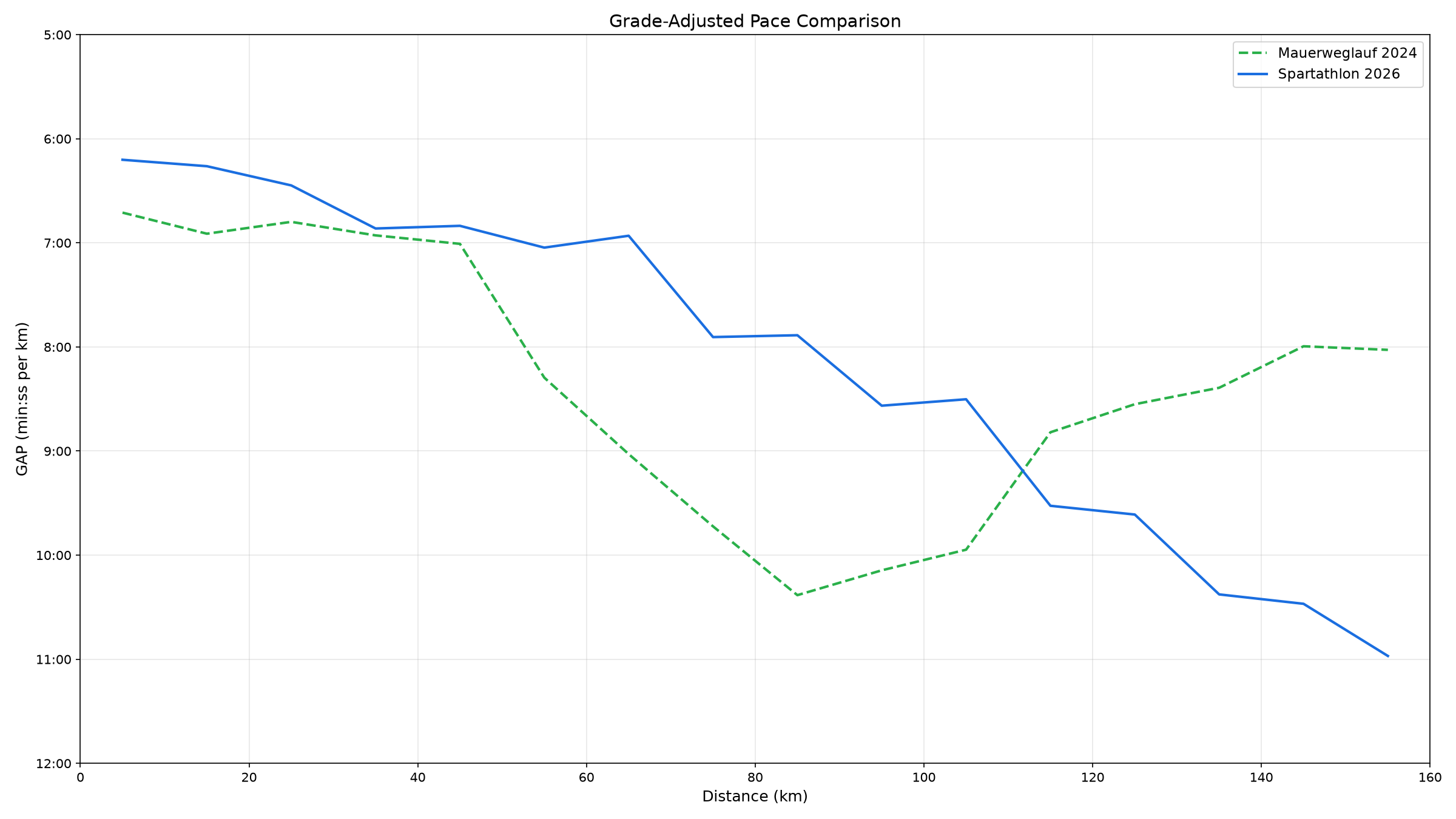
From studying the GPX at home, I knew the top of the pass would be the 100-mile mark. I reached it at 05:16, where a couple of runners were sitting in a small kiosk. That was 100 miles with more than 2,000 meters of ascent in just under 22 hours. Faster than my second Mauerweg, a course that is virtually flat, not even two years ago. We had come a long way, I thought.
I was one of the few people running the descent. It was my kind of terrain, and the last of it I would get. I might as well enjoy it.
Nestani
I reached Nestani, CP52, kilometer 170, and for the first time I noticed I was moody. I asked Lefteris for coffee and took it with me to the bathroom. Everything I had on was wet, from shoes to underwear, so we changed all of it. That took time.
When I left, it was 07:10. One hour behind Plan A. Twenty minutes ahead of the cutoff.
I had better get going. On the way out, there was Yousuke again, at the same steady pace as always.
The math was simple. Three of the eight milestone segments were left. I was tired, chafed and blistered, but my spirits were up and my stomach was fine. The cutoffs would loosen from here, the last 20 kilometers were downhill, and the weather was still mild. If I could take 40 minutes out of each remaining segment, I would arrive in Sparta two hours ahead of the cutoff, at around 34 hours. Plan A, rescued.
That was the plan, anyway.