


Annoyed. That is how I feel when strength day comes up on my calendar. Even starting this post has been tedious.
I am not sure why. Maybe it is the gym culture. Maybe I am just bad at following workout instructions. The only thing I know is that I will take any excuse to skip it.
And yet it is probably the reason I am still running at all.
Between 2022 and 2023 I had a case of plantar fasciitis that kept me out for over a year. Sometime in there I read The Rise of the Ultra Runners by Adharanand Finn.
There is a story in it I have thought about ever since. The author is dealing with injuries in his lower body that will not resolve. After trying and failing with every obvious solution, the culprit turns out to be an old wrist injury. Not the foot. Not the knee. The wrist. The book introduced me to NeuroKinetic Therapy, and with it the idea that the body compensates. When something is weak or damaged, other parts take over the work, and the place where the pain shows up is often not the place where the problem lives.
I was sitting there with a foot that had not let me run in months. It rang a bell. A few months earlier, I had taken a bad fall skateboarding and landed on my shoulder. My neck and shoulder had been stiff ever since. Could that be the cause?
I read more about NeuroKinetic Therapy, found an Ergotherapeut, and started working on fascia release, stretching, and strength work.
I got the point. Getting back to running was not only about the foot. It involved rebuilding strength in parts of my body I had neglected while chasing weekly volume. Hip flexors and core, mostly.
So, if I wanted to keep running, running was not going to be enough on its own.
Three reasons why
I never doubted the benefits of strength training. I knew I needed to take it seriously. What I struggle with is the execution, and mostly for three reasons.
Consistency. The obvious answer was to join a gym. But I am constantly out of town, for work and otherwise, and going to the gym on and off is not my thing. I need repetition for something to stick. A routine that breaks every time I board a plane never had a chance to become a routine at all.
Decision fatigue. I dislike standing in front of the barbells having to decide what to do that day. And then the next day. And then the day after. I would default to the same workouts every time. In a sense, choosing was costing me more than lifting.
Peak weeks. The weeks when I most need my body to be balanced are the weeks with the least room in them. When the plan says 160 kilometers, strength work is the first thing off the calendar, which defeats the purpose. Consistency that collapses under load is not consistency.
Bands
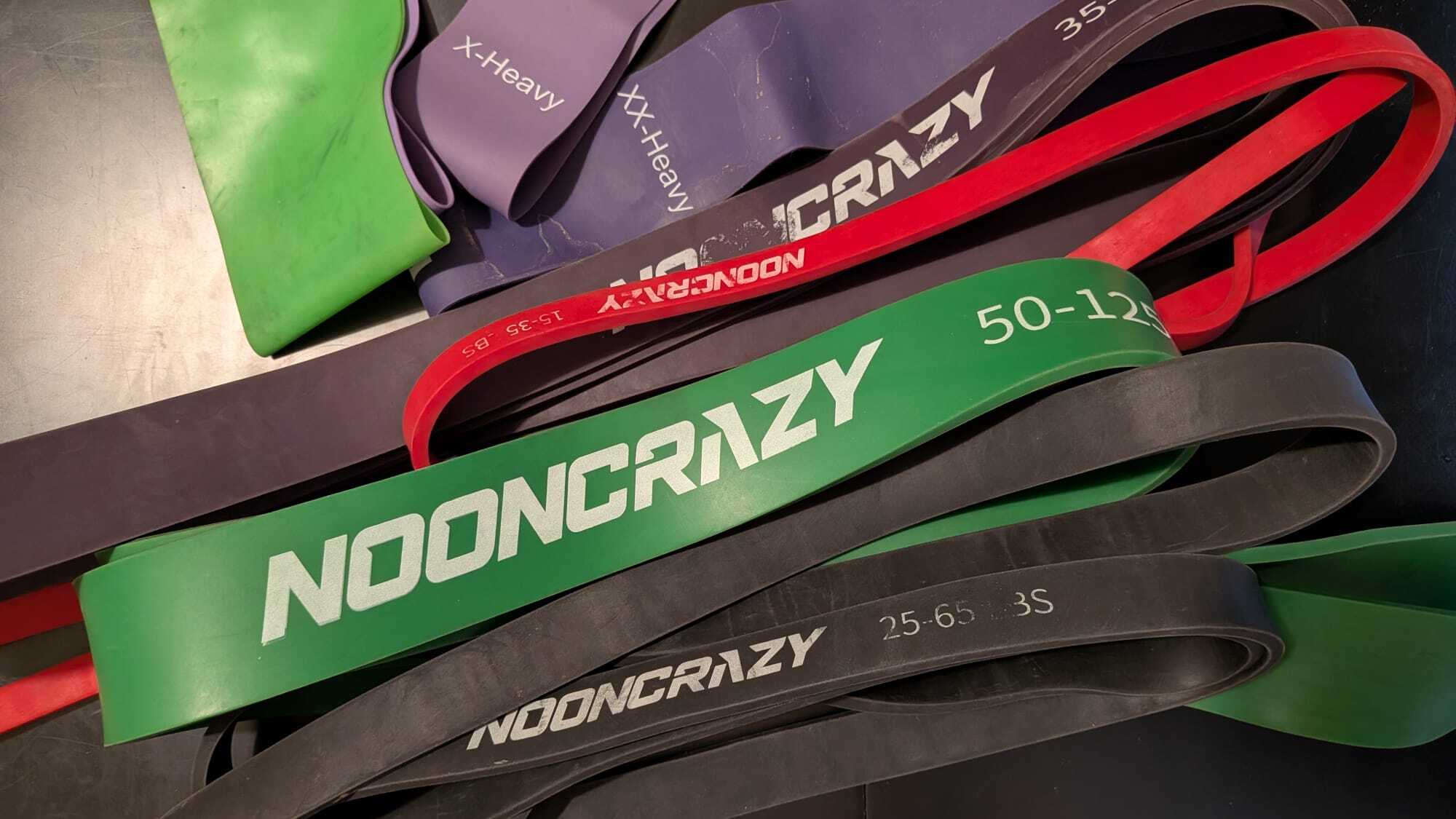
The unlock was resistance bands.
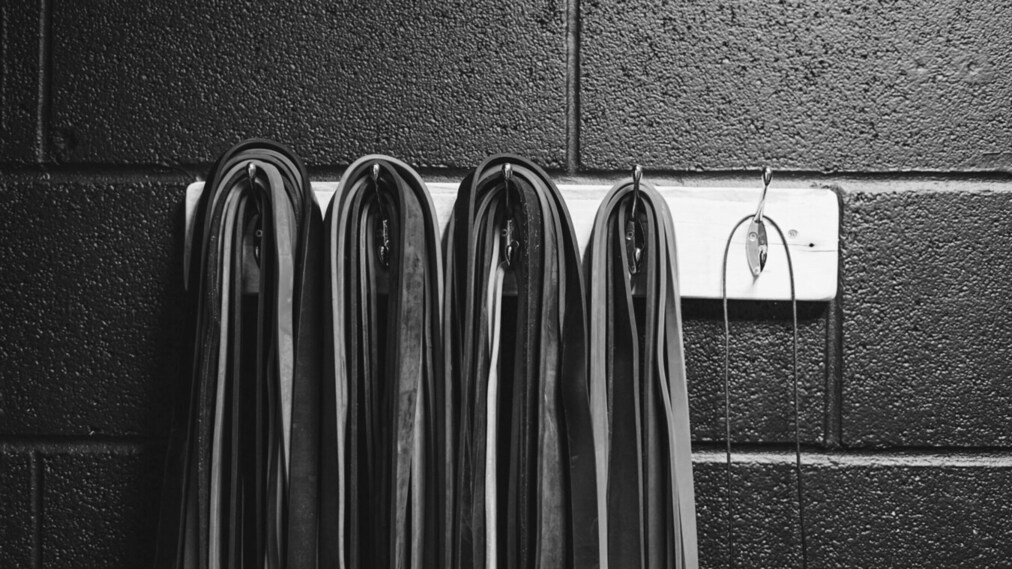
I have a set in different strengths, plus a slant board for stability work, tibialis and calves. All of it lives in a small pile at home, and all of it fits in a carry-on. I can train at home, at the park, next to the track after running, or in a hotel room.
The slant board is three foam pieces that fit together into one board. Versatile, and useful for foot strength. They are light but bulky, so they stay home when I travel. On the road I use a towel or a staircase step for the same calf and tibialis work.
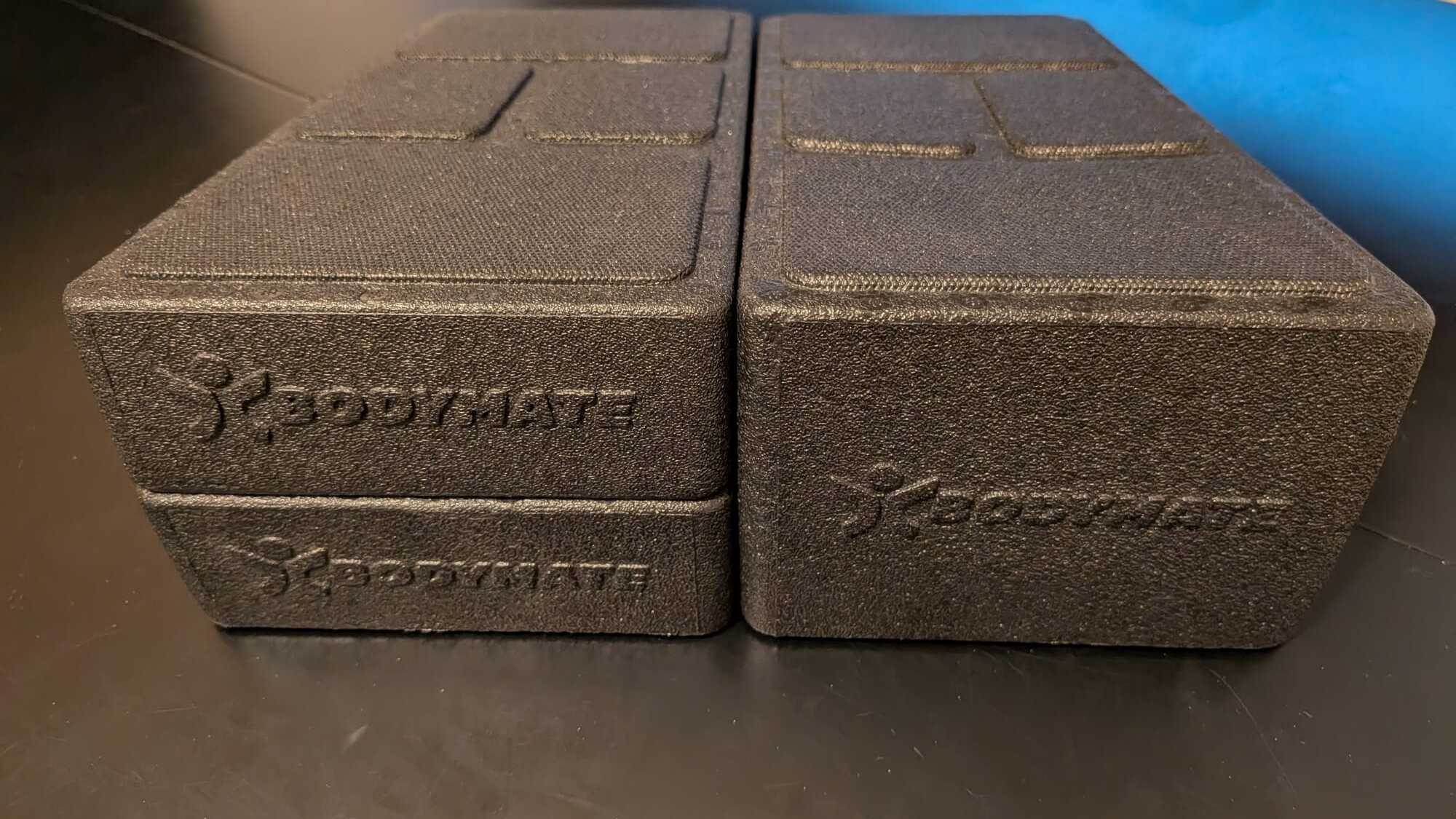
There is now no location on earth where I can claim I could not do the workout.
Borrowing a format
I have done a lot of classes with Beat81, the functional fitness people, and much of their strength work is band based. I borrow their exercises, but what matters more is the format. Eight exercises, worked in pairs. Thirty seconds on the first, fifteen seconds rest, thirty seconds on the second, then back to the first. Once the pair is done, move to exercises three and four, and so on. Then repeat the whole thing.
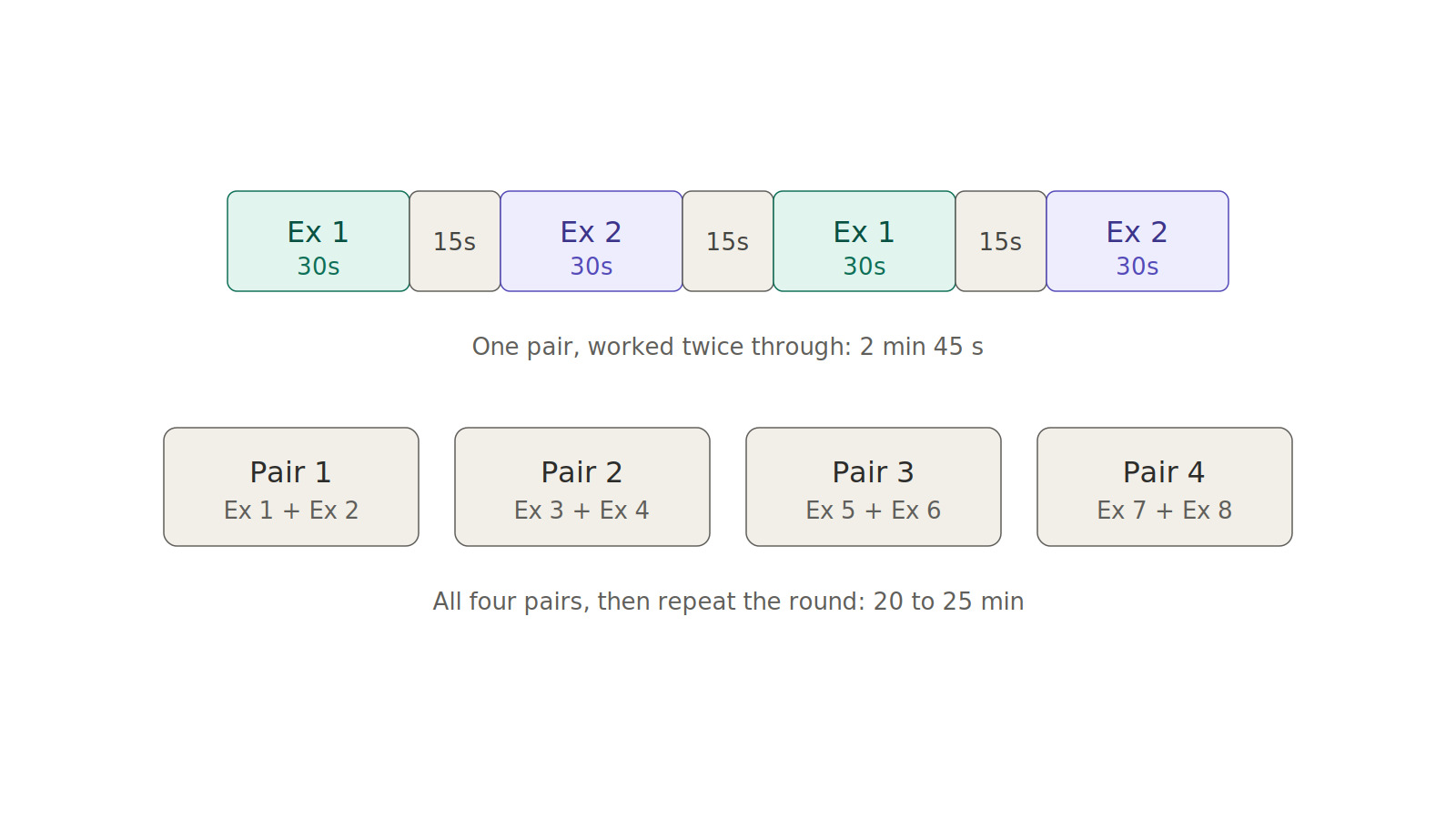
That gives me a 20 to 25 minute session. No commute, no equipment queue, no changing rooms.
I do two a week. One for legs and core, one for back, arms, shoulders and chest.
An algorithm that decides
The variety problem I solved the way I solve most things, with a spreadsheet.
Instagram turned out to be a good source of ideas, for upper body and core as much as for legs. The account I follow is band.workout.pros. Anything worth trying goes into an Excel sheet, tagged by body part and by equipment.
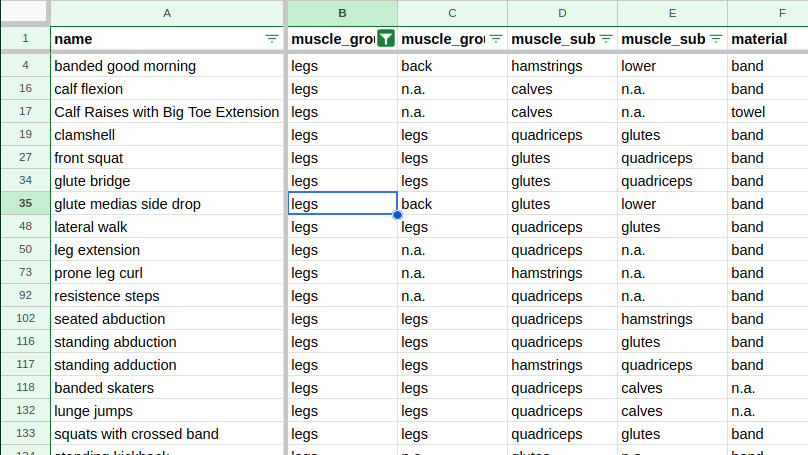
On top of that sheet I built a small algorithm that assembles the session. It picks at random, balances muscle groups and subgroups across the eight slots, and excludes anything I have done in the last two sessions. Then it emails it to me. I open the mail and either follow it or adjust as I go. A very simple personal trainer.
Always after, never before
Ideally, strength days land on days I do not run. During high volume weeks that is not possible, so running and strength share a day. When they do, the strength session always comes after the run. Never before.
I want the band work to be the controlled part of the day. Coming into it on tired legs means I am not going to overreach, and I am not carrying workout fatigue into an interval session where my mechanics matter. Bands help here too. The resistance scales with how hard I pull, rather than sitting fixed on a machine. On a bad day the workout is quietly easier, and I do not have to decide that in advance.
A word on supplements
I have been taking clean whey protein since before I started running long distances. A shake with almond milk after a run or a strength session is a habit at this point.
For this Spartathlon block I started mixing creatine into it. I had read enough good things about it to want to try.
The case for it is short, high intensity work, where the body needs quick bursts of energy. The case against it, for someone like me, is that it does little for prolonged endurance and may work against it. Creatine makes your muscles store more water, which means carrying more weight over long runs.
It is difficult to reach an objective conclusion inside a single training block, so these are impressions rather than findings. What I notice is recovery. The day after a long run (20+ kilometers) does not feel as heavy as it used to. Whether that is creatine, the strength work, or the fact that I am simply running more than ever, I cannot separate.
Where it stands now
I still do not like strength training. It has become easier to execute, but I do not look forward to it.
Twenty minutes, twice a week, from anywhere, with the session chosen for me. It is probably the bare minimum, and probably not enough by the standards of people who take this seriously.
But I have been injury free since 2023, and this has been the highest volume summer I have ever run. The parts of my body that used to be weak are still not strong. They are maintained.
Will maintained be enough for the race? I will find out soon.